
The Black Shark 5 Pro is the Chinese company’s latest flagship phone. Equipped with the Qualcomm Snapdragon 8 Gen 1 processor, a 6.67-inch display, a 4650mAh battery and 120W super-fast charging, it aims to balance a mobile gaming experience with typical daily use. Audio specs include two stereo speakers.
We subjected the Black Shark 5 Pro to our rigorous SBMARK Audio test suite to measure its performance both when recording sound using its built-in microphones, and when playing audio through its speakers.
In this review, we’ll break down how it fared across a variety of tests and several common use cases.
Overview
Key audio specs include:
- Stereo speakers: top and bottom for music and top front for calls
- 3.5mm socket
Reproduction
Pros
- Excellent overall performance, even at maximum volume
- Excellent tonal balance
- Great stereo image
- Very good dynamic performance
versus
- Some minor artifacts have been identified, particularly when pausing and playing music
Registration
Pros
- Excellent performance in all attributes
- Excellent tonal balance.
- Excellent performance at high SPL
- Seamless processing, natural and lifelike recordings without artifacts
- Good wind noise management
versus
- The extreme high-end extension is slightly lacking, although the tonal balance remains realistic
- The bass sounds slightly hollow
- Audio zoom induces a loss of tonal balance and introduces artifacts
The Black Shark 5 Pro follows in the footsteps of its predecessor and becomes the new top scorer in our audio charts database, scoring an impressive 161 in our tests. Overall, the Black Shark 5 Pro showed outstanding performance across all tested categories and use cases, both as a recording and playback device. It is therefore perfect for watching movies, sending reminders, playing games, making selfie videos, listening to music or recording loud concerts.
In playback, with the exception of artifacts, the Black Shark 5 Pro outshines its competitors in nearly all of our tested categories and use cases, whether it’s playing music, watching movies, or gaming. Timbre reproduction is excellent, with a rich yet natural midrange, clean and airy treble, and a very pleasant low-end boost. The dynamics and spatial attributes are both impressive, as when it comes to volume, the 5 Pro is simply the loudest device we have tested to date. While not flawless, the phone’s ability to control playback sound artifacts is overall very good, particularly time artifacts, being remarkably well handled. However, be aware that occasional clicks are audible when playing, pausing, or skipping a track.
As a recording device, the Black Shark 5 Pro offers equally outstanding performance. Recorded audio can reach impressive levels of volume while exhibiting very few artifacts. Additionally, timbre capture is pleasant yet natural, dynamics are excellent, and spatial attributes are engaging and realistic, even in selfie videos. In light of all these skills, background acquisition is, predictably, very satisfying, natural and well balanced. In terms of recording use cases, this makes the Black Shark 5 Pro suitable for recording concerts or meetings, filming selfies or life videos, and creating reminders.
Test summary
Learn about SBMARK audio tests: For scoring and analysis in our smartphone audio reviews, SBMARK engineers perform a series of objective tests and undertake more than 20 hours of perceptual assessment under controlled laboratory conditions.
(For more details on our reproduction protocol, click here; for more details on our registration protocol, click here.)
The following section collects the key elements of our exhaustive tests and analyzes performed in SBMARK laboratories. Detailed performance evaluations in the form of reports are available upon request. Do not hesitate to contact us.
How the audio playback score is composed
SBMARK engineers test playback through smartphone speakers, whose performance is evaluated in our labs and under real-life conditions, using apps and default settings.
Hear about the playback performance of the smartphone tested in this comparison with some of its competitors:
Recordings of smartphones that play some of our music at 60 LAeq in an anechoic environment from 2 microphones in AB configuration, at 30 cm
Here’s how the Black Shark 5 Pro fares in playback use cases compared to its competitors:
Playback of use case scores
The Timbre score represents how well a phone reproduces sound across the audible tonal range and takes into account bass, midrange, treble, tonal balance and volume dependence. It is the most important attribute for reproduction.
As a playback device, the tonal performance of the Black Shark 5 Pro not only surpasses all other phones we have tested. The phone’s speakers excel in every frequency range, as well as balancing them – the overall tonal balance is excellent, as well as staying fairly consistent regardless of listening volume. At the lower end of the spectrum, the presence of a bass boost is very pleasant and helps to get a sharper sense of pitch on the lower notes. However, this means that bass can sometimes feel a bit over the top, especially on already heavy sounds like electronic music.
Music playback frequency response
A 1/12 octave frequency response graph, which measures the volume of each frequency emitted by the smartphone when playing a pure sine wave in an anechoic environment.
The midrange sounds warm and rich, with very precise, natural and full voices. Finally, the highs sound very open and airy.
The Dynamics score measures the accuracy of changes in the energy level of sound sources, such as the precision with which a bass note or the impact sound of drums is played.
In the dynamic category, Black Shark’s latest flagship shares first place with its predecessor. Overall, the dynamics are well defined and provide a lot of energy. Thanks to the extended low range, the punch is particularly punchy at nominal level and the bass accuracy at low volume is quite impressive.


The phone works best with softer music genres; since “dense” tracks are played harder, compression emphasizes the midrange while slightly decreasing the low end and punch. As for the attack, it is very satisfying from a nominal level up to the maximum volume.
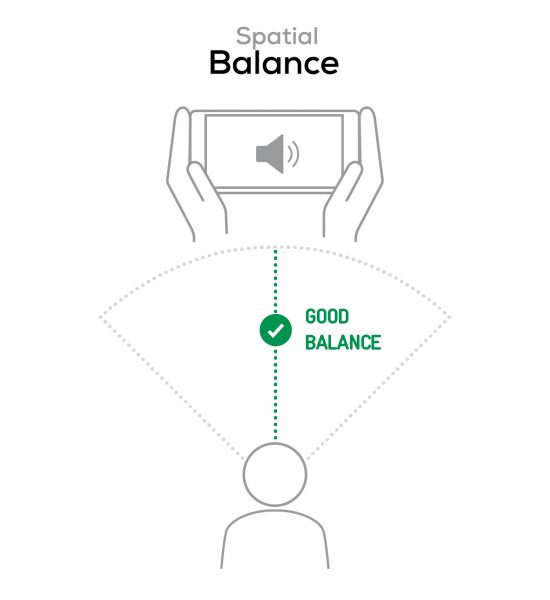
Secondary attributes for spatial tests include identifying the position of a specific sound, its positional balance, distance and amplitude.
Spatial attributes are no exception, with a perfectly centered balance between the left and right channels, a large stereo field width and a realistic rendition of distance. As for the localizability of sound sources, although it is very precise when watching films, it is slightly less so in other use cases.

The volume score represents the overall volume of a smartphone and how the volume gradually increases and decreases based on user input.
Simply put, the Black Shark 5 Pro is the loudest device our engineers have tested so far. Furthermore, even the performance at minimum volume is exemplary, leaving the audio very clear and understandable. Here are some sound pressure levels (SPLs) measured when playing our sample recordings of hip-hop and classical music at maximum volume:
| Hip-Hop | Classic | |
| Black Shark 5 Pro | 77.1 dBA | 70.1 dBA |
| Apple iPhone 13 Pro Max | 72.4 dBA | 69.5 dBA |
| Google Pixel 6 Pro | 73 dBA | 69 dBA |
Speaker volume is another big selling point, reaching six points higher than the previous title holder in this category, the Realme X2 Pro. As seen in the graph below, the distribution of volume increases is extremely homogeneous from level lowest to highest.
The graph below shows the gradual changes in volume from minimum to maximum. We expect these changes to be consistent across the range, so that all volume levels match user expectations:
Music volume texture
This line graph shows the relative playback volume versus the user-selected volume step, measured at different volume levels with correlated pink noise in an anechoic box recorded on axis at 0.20 meters.
The Artifacts score measures the extent to which sound is affected by various types of distortion. The higher the score, the less noise you notice. Distortion can occur due to the sound processing in the device and the quality of the speakers.
While certainly not as spectacular as the other categories, the performance of the artifacts remains very satisfactory overall. Despite the phone’s incredibly loud maximum volume, related artifacts (such as excessive compression) are handled very well. That said, the excess bass mentioned earlier can induce artifacts on very low kicks and playing / pausing or skipping a track can generate clipping noises.


Total harmonic distortion reproduction (maximum volume)
This graph shows the total harmonic distortion and noise in the audible frequency range.
It represents the distortion and noise of the device reproducing our test signal (0 dB Fs, Sweep Sine in an anechoic box at 40 cm) at the maximum volume of the device.
How the score of the audio recording is composed
SBMARK engineers test the recording by evaluating recorded files on reference audio equipment. These recordings are performed in our labs and in real-life conditions, using apps and predefined settings.
Here’s how the Black Shark 5 Pro fares in recording use cases compared to its competitors:
Record of use case scores
The Timbre score represents how well a phone captures sounds across the audible tonal range and takes into account bass, midrange, treble and tonal balance. It is the most important attribute for registration.
As a recording device, the Black Shark 5 Pro excels at capturing timbre, delivering a pleasant yet natural frequency response and a particularly harmonious tonal balance regardless of the orientation of the phone, even in noisy environments.
Life video frequency response
A 1 / 12th octave frequency response graph, which measures the volume of each frequency captured by the smartphone when recording a pure sine wave in an anechoic environment.
The highs sound very clear without ever getting harsh. It benefits from an appreciable high-end extension and manages to never get aggressive, even in noisy environments. The midrange is homogeneous and consistent, exhibiting a clear upper midrange and a strong low bass midrange. Both musical and vocal recordings are very enjoyable, regardless of the sound pressure level. The bass is versatile, offering appreciable depth to everyday recordings while sounding powerful (but still clean) in loud concert situations.
Note that a small notch in the bass range induces a slightly hollow sonority of what would otherwise have been a hearty bass tone. That said, extreme low-end frequencies are highlighted thanks to that same notch. It’s also worth bearing in mind that using the audio zoom feature results in a significant loss of bass and treble.
The Dynamics score measures the accuracy of changes in the energy level of sound sources, such as how accurately the explosives of a voice (p, tek, for example) are reproduced. The score also considers the signal-to-noise ratio (SNR), such as how loud the main voice is compared to the background noise.
The 5 Pro’s microphones are also masterful at capturing dynamics. First of all, the dynamic range is really great, with no perceptible compression. Also, the envelope is very satisfying, especially when recording in noisy environments where the recordings show almost no sign of pumping. Finally, the signal-to-noise ratio is flawless, benefiting from a very well-tuned noise reduction algorithm that allows voices to stand out naturally and evenly from the background.


Secondary attributes for spatial tests include locating the position of a specific sound, its positional balance, distance and amplitude on recorded audio files.
In recordings, the spatial attributes are slightly less impressive than on the 4 Pros, but we’re being picky here. Accurately balanced frequency response and exceptional signal-to-noise ratio allow voices to stand out from the background, improving distance rendering. Stereo width is not only great in landscape videos, but also very good in selfie videos, and the localizability of distinct sound sources is precise.

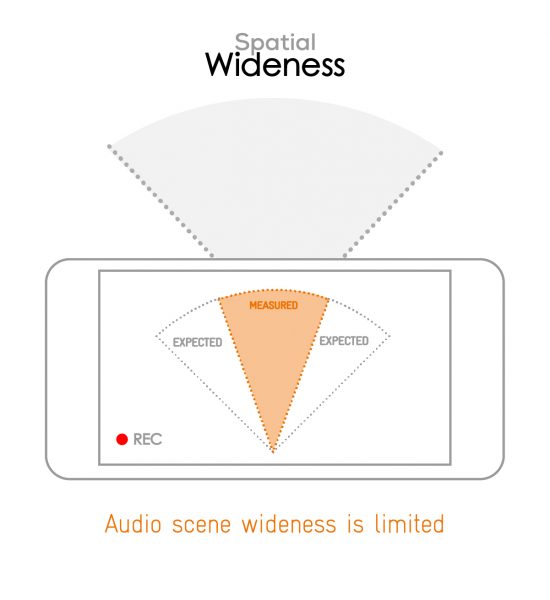
Directivity of registration
Smartphone directivity graph when recording test signals using the camera app, with the main camera. It represents the acoustic energy (in dB) on the angle of incidence of the sound source. (Normalized to the 0 ° angle, in front of the device.)
The volume score represents the normalization level of the audio on the recorded files and how the device handles noisy environments, such as electronic concerts, during recording.
Just like in playback, the Black Shark 5 Pro is the loudest recording device we’ve tested to date, reaching impressive recording levels with very little distortion and no other harmful artifacts. Here are the sound levels recorded in the audio and video files, measured in LUFS (Loudness Unit Full Scale); as a reference, we expect loudness levels to be higher than -24 LUFS for recorded content:
| Match | Life video | Selfie video | Memo | |
| Black Shark 5 Pro | -21.3 LUFS | -17.5 LUFS | -16.4 LUFS | -16.4 LUFS |
| Apple iPhone 13 Pro Max | -25.5 LUFS | -22.7 LUFS | -20.1 LUFS | -18.2 LUFS |
| Google Pixel 6 Pro | -27.5 LUFS | -19.6 LUFS | -17.6 LUFS | -20 LUFS |
The Artifacts Score measures the extent to which recorded sounds are affected by various types of distortions. The higher the score, the less noise you notice. Distortions can occur due to the sound processing in the device and the quality of the microphones, as well as user handling, such as the way the phone is held.
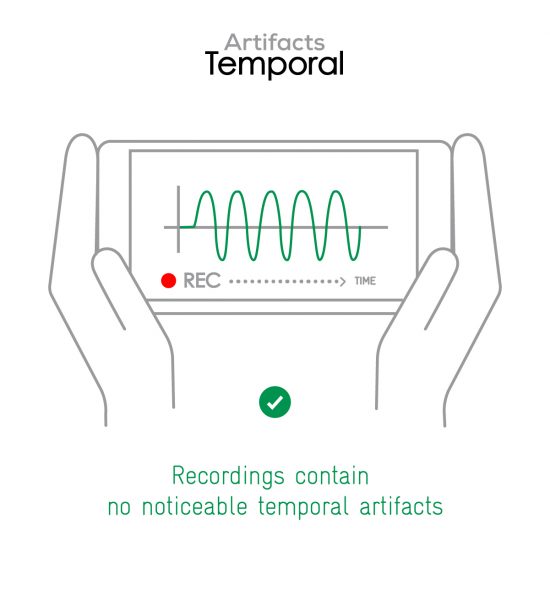
From a recording standpoint, the Black Shark 5 Pro excels at minimizing sonic artifacts. In most use cases, even in high SPL scenarios, the captured audio is simply devoid of perceptible artifacts, whether temporal (such as compression), spectral (distortion), or noise-related. Noise processing is actually done efficiently and seamlessly. On another note, total microphones occlusion is prevented by processing that can induce slight artifacts such as occasional (and quite undisturbed) volume drops. Wind noise is handled well, but using the audio zoom feature introduces hissing and noises.

In this audio comparison, you can hear how this smartphone handles wind noise compared to its competitors:
Recordings of a voice sample with light background noise, facing a turbulent wind of 5 m / s
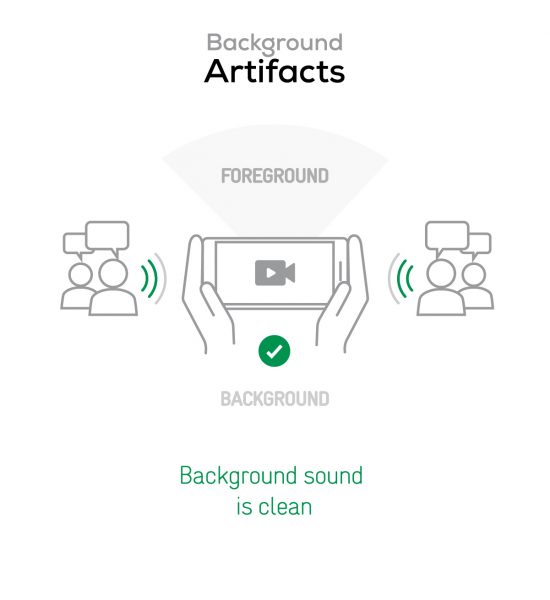
Background evaluates how naturally the various sounds around a voice blend into the video recording file. For example, when recording a speech at an event, the background should not interfere with the main voice, but should provide context for the surrounding environment.
Recorded backgrounds sound very natural and unobtrusive thanks to a coherent and well-tuned tonal balance. While the low end provides enough depth to the background without letting it take up too much space, the highs are bright but still soft. Overall, our engineers did not notice any artifacts.



Start a new Thread