
Today, the Qualcomm team unveiled its new flagship – the Snapdragon 8 Gen 2 chipset. Performance has been improved on all fronts compared to the Gen 1 model, performance we will experience soon as the first Gen 2 based devices are just behind the angle.
This chip is formally known as the SM8550-AB and is manufactured on a 4nm node. Here are more details about its components.
CPUs and GPUs
Qualcomm has focused on improving energy efficiency, but the new chip still brings appreciable accelerations. The new trio of Kryo CPUs deliver up to 35% more performance with up to 40% more efficiency.
Clock speeds are the same as the 8+ Gen 1, but core composition is not. The single Kryo Prime core (Cortex-X3 based) runs at 3.2GHz (3.1872GHz to be exact) to deliver high single-threaded performance. This time around, however, it’s supported by four Performance cores (instead of three) to better handle multi-threaded workloads – these cores run at 2.8GHz. Finally, there are three (not four) Efficiency cores at 2, 0GHz.
Gen 2 offers support for new, faster memory technologies. For RAM it runs on LP-DDR5X up to 4,200 MHz (LP-DDR5 to 3,200 MHz). For archiving it can use the new UFS 4.0 format (compared to UFS 3.1).
The latest Adreno GPU promises up to 25% higher performance with up to 45% higher energy efficiency. It also brings hardware-accelerated ray tracing support to the Snapdragon platform. Now that ray tracing hardware is available from major chipset vendors for Android, we could see mobile game developers embrace the new technology as they have on PC and consoles. Also, this GPU is the first to support Vulkan 1.3 (along with OpenGL ES 3.2).

The Snapdragon 8 Gen 2 can drive on-device displays with QHD+ resolution up to 144Hz or 4K up to 60Hz. It also supports external displays up to 4K at 60Hz (with 10-bit Rec. 2020 color gamut, HDR10+ and Dolby Vision to boot). Qualcomm has also finally enabled AV1 video decoding: streams up to 8K at 60fps (with HDR) are supported.
Cameras
Qualcomm boasts that Sony’s sensors with Digital Overlap HDR (DOL-HDR) and Samsung’s 200MP HP3 have been optimized to work with the Snapdragon ISP. Like its predecessor, the Gen 2 offers a triple 18-bit ISP that can handle up to three 36MP (30fps) cameras simultaneously or go up to 200 PM for a single camera. 108MP sensors are supported with zero shutter lag.
For video, the chipset can record 8K HDR footage at 30fps (and capture 64MP photos simultaneously), 4K at 120fps, and even slow-motion video (720p at 960fps). It supports multiple HDR formats including HDR10+, HLG and Dolby Vision. Using DOL sensors, it can capture up to four exposures for each frame of video.
Connectivity
The Snapdragon 8 Gen 2 updates to the new Snapdragon X70 modem. It supports both mmWave and sub-6GHz 5G, of course. Its peak downlink speeds are 10Gbps, peak uplink is 3.5Gbps (similar to its predecessor).
This modem supports Dual-SIM, Dual-Active (DSDA) operation where two 5G (or 5G+4G) SIMs are active at the same time.
Local connectivity brings the capabilities of the upcoming Wi-Fi 7 standard (802.11be), thanks to the new FastConnect 78000 system. It reaches 5.8 Gbps (compared to 3.6 Gbps on the previous chip). In addition to speed, the new standard also reduces latency (Qualcomm calls it “wire-like”).

Snapdragon 8 Gen 2 FastConnect 7800 system offers low latency Wi-Fi 7 and Bluetooth
As before, the FastConnect system has Bluetooth 5.3 connectivity. With the latest Snapdragon audio system it can deliver 48kHz lossless music streaming and the lowest 48ms latency ever for gaming.
There’s not much to report for wired connectivity: the chip supports USB 3.1 with Quick Charge 5 (which is just a wrap around the USB Power Delivery standard).
TO THE
The new Hexagon processor introduces support for a new INT4 format on a mobile Qualcomm chip for the first time. It promises 60% better performance per Watt than previous techniques.
The Hexagon is also faster overall: Qualcomm claims AI performance has been boosted 4.35x. That power can be harnessed to help the camera recognize which parts of the image are a face, hair, clothing, background, and so on, and apply processing differently to them.
Coming soon
The Snapdragon 8 Gen 2 will be adopted by major Android manufacturers, Qualcomm lists the following in its press release: Asus ROG, Honor, iQOO, Motorola, nubia, OnePlus, Oppo, Red Magic, Sharp, Sony, vivo, Xiaomi, Meizu and ZTE.
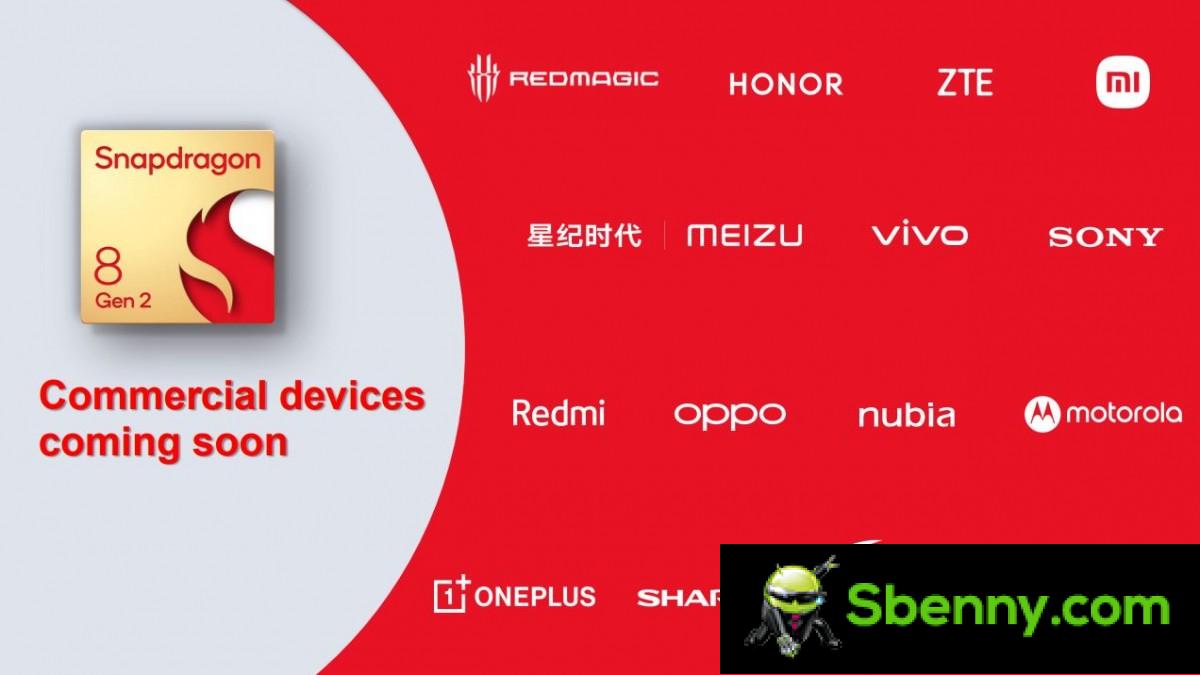
It goes on to say that the first Gen 2-based phones will be available later this year, but it doesn’t say which manufacturers will go first. There is no mention of Samsung and the upcoming S23 series.


Start a new Thread