
Apple’s first custom chipset, the Apple A4, launched in 2010 with the original iPad and was also introduced in the iPhone 4 a few months later. The A4 was manufactured by Samsung and used an enhanced Cortex-A8 CPU core nicknamed “Hummingbird”.
Hummingbird was co-developed by Samsung and Intrinsity and was announced in 2009 as “the world’s fastest ARM Cortex-A8 processor”. Multiple customizations had to be made for the core to hit its 1 GHz target. Apple acquired Intrinsity a few months after unveiling the iPad. And a couple of years earlier he had acquired PA Semi.
Following these key acquisitions, Apple began working on internal chipset designs for use in its portable products. Today’s story begins in 2012, when we will focus on the advanced X-series chips, predecessors of the groundbreaking Apple M1. AX chips are mainly used in iPads, but have occasionally appeared in Apple TVs as well.
The second generation iPad introduced the Apple A5 to the world in 2011. It still used standard components, ARM’s Cortex-A9 CPU cores and Imagination’s PowerVR SGX543 GPU cores. The third-generation iPad arrived a year later with an improved version of that chip, dubbed the Apple A5X, which kicked off the game.
The A5X doubled the GPU cores (MP2 to MP4) and also featured a new quad-channel memory controller, which offered data transfer speeds of up to 12.8 GB / s, roughly triple the bandwidth of the ‘A5.

Future AX chipsets would follow the same game plan: they would use the same hardware, just more. Tablets are larger than phones, which means they have larger batteries and more surface area to dissipate heat, so they could handle more powerful chipsets.
The Apple A6 is distinguished by the introduction of the first custom CPU core designed internally by Apple, called “Swift”. The GPU still came from Imagination. The A6X was a little underwhelming as it only added an extra GPU core.
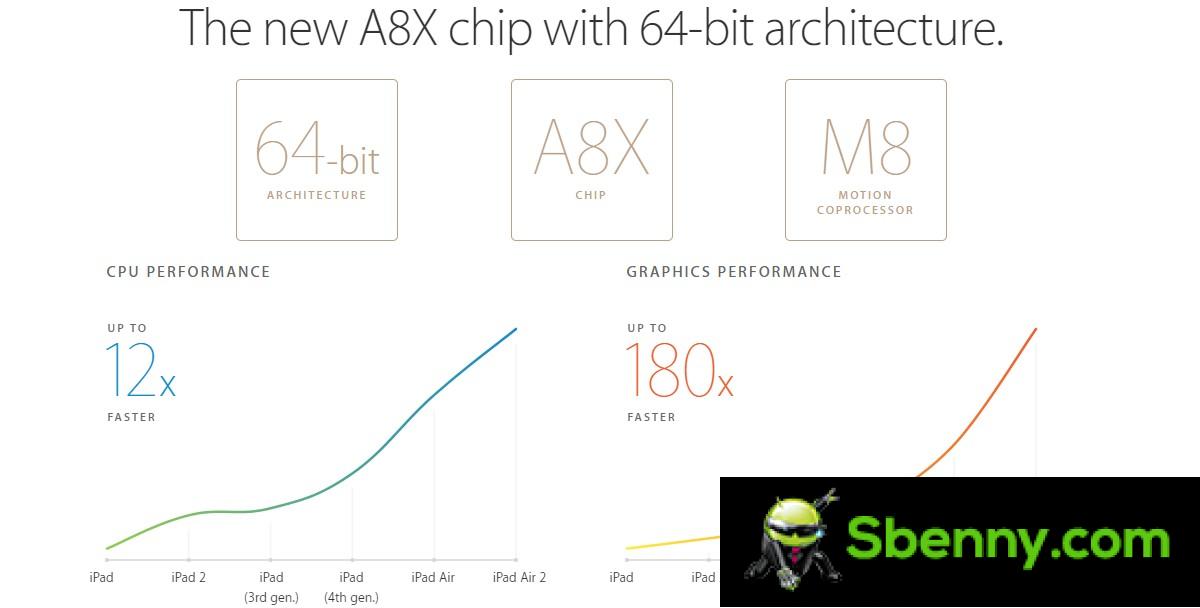
A couple of years later came the Apple A8X, the first in the series to expand the CPU hardware and GPU. It added an additional Typhoon core, for a total of three, while the GPU core count doubled to eight. The A9X went back to having the same CPU as the regular A9, but that was the last time: from that point on, all AX chipsets would have larger CPUs
The 2016 Apple A10 chipset was the first of the company to adopt a big.LITTLE architecture. It had two large Hurricane cores along with two small Zephyr cores. A year later the A10X arrived with three of each, also doubling the GPU’s core count.
Small cores are great for efficiency, but having more than a few doesn’t add much performance. That’s why the 2018 Apple A12X chipset only doubled the number of large CPU cores (to four), using the same number of small cores (even four). The GPU has been upgraded to a 7-core design, an 8-core version would arrive in 2020 as the Apple A12Z.
Let’s move on to 2020: after years of using Intel processors, Apple said goodbye and announced the first batch of Macs with Apple M1 technology. This also marked a transition from x86 to ARM, the same ARM instruction set that powered its iPhones and iPads.
And it is no coincidence, the Apple M1 used slightly modified versions of the components of the A14 (the chip inside the iPhone 12 and the fourth generation iPad Air): the large Firestorm cores and the small Icestorm cores, the same GPU architecture as well.
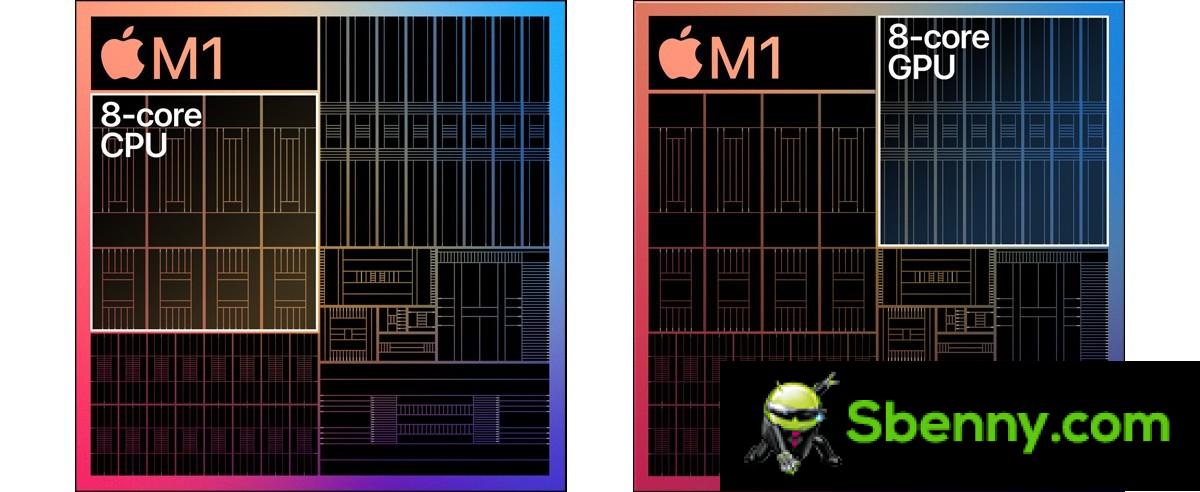
But as we have already seen, the trick to making the chipset faster is to add more cores. The M1 doubled the large CPU cores and doubled the GPU (although it offered 7-core GPU chips as a cost-saving measure). As with the 12X, the small CPU cores remained intact. It helped that Apple’s designs were already in the lead in both performance and efficiency (TSMC deserves some of the credit), so the M1 handled desktop tasks with ease, even when it was passively cooled.
The Apple M2 chipset announced earlier this month follows the same pattern, although this time around it is based on the A15 (iPhone 13) chipset. The M1 had Pro, Max and Ultra variants, surely the M2 will too.
These simply use different multipliers, for example the M1 Pro has 50% or 100% more CPU cores than the base M1 and doubles the GPU cores. The Pro has reduced the small cores to two, but as already discussed only a few of these are needed. The Max uses the same formula as the CPU, but offers 3 to 4 times more GPU cores than the base M1. The Ultra doubles CPU and GPU resources (it actually consists of two Pro chips).
| 2012/2012 | Apple A5 | A5X |
|---|---|---|
| Large CPU cores | 2x Cortex-A9 | 2x Cortex-A9 |
| Small CPU cores | – | – |
| GPU | SGX543 MP2 | SGX543 MP4 |
| 2012 | Apple A6 | A6X |
| Large CPU cores | 2x Quick | 2x Quick |
| Small CPU cores | – | – |
| GPU | SGX543 MP3 | SGX554 MP4 |
| 2014 | Apple A8 | Apple A8X |
| Large CPU cores | 2x typhoon | 3x typhoon |
| Small CPU cores | – | – |
| GPU | 6XT 4 core | 6XT 8 cores |
| 2015 | Apple A9 | Apple A9X |
| Large CPU cores | 2x Twister | 2x Twister |
| Small CPU cores | – | – |
| GPU | 7XT 6 cores | 7XT 12 cores |
| 2016/2017 | Apple A10 | Apple A10X |
| Large CPU cores | 2x Hurricane | 3x Hurricane |
| Small CPU cores | 2x Zefiro | 3x Zephyr |
| GPU | 7XT GT 6 cores | 12 cores |
| 2018/2020 | Apple A12 | Apple A12X / A12Z |
| Large CPU cores | 2x Vortex | 4x Vortex |
| Small CPU cores | 4x Storm | 4x Storm |
| GPU | G11P 4 core | 7/8 cores |
| 2020 | Apple A14 | Apple M1 |
| Large CPU cores | 2x Firestorm | 4x Firestorm |
| Small CPU cores | 4x Ice Storm | 4x Ice Storm |
| GPU | Apple 4 core | Apple 7/8 core |
| 2021/2022 | Apple A15 | Apple M2 |
| Large CPU cores | 2x avalanche | 4x avalanche |
| Small CPU cores | 4x Snowstorm | 4x Snowstorm |
| GPU | 4 core | 8/10 cores |


Start a new Thread