
The tobacco worm (Lasioderma serricorne) is an insect belonging to the order Coleopterafamily Anobiidae. In English-speaking countries it is known as cigarette beetle. However, do not be fooled by the vulgar name of him, in fact this beetle not only attacks tobacco, but also foodstuffs in general and more. It is in fact very polyphagous, and is a close relative of another parasite of preserved foods, namely theanobio of bread.
The Lasioderma serricorne it is believed to originate in South America, but today it is widespread all over the world, therefore it is a cosmopolitan parasite.
In this article we see how to recognize the tobacco worm, what are the damage it causes in the pantries and the solutions to avoid infestations.
Description of the tobacco worm
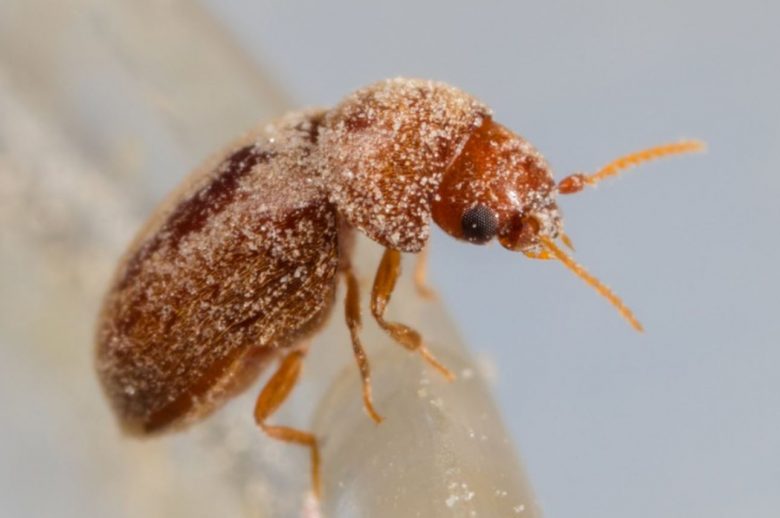
The Lasioderma serricorne it is a small, globular ovoid-shaped beetle, no larger than 2.5 mm. The color is brown, tending to yellowish or reddish, with the body covered with a thin blond hair.
Its head is curved downwards, which is hardly noticeable as it is almost completely hidden by the pronotum. It is equipped with serrated antennae and wings (elytra) covering the entire abdomen and with fine punctuation.
Larvae

The tobacco worm larva is responsible for damage to foodstuffs. It is curved in the shape of a C, white-cream color with a brown head. It is also decorated with long brown bristles. At full maturity it measures 4 mm in length
What foods does the tobacco worm attack?
Despite its name, the tobacco woodworm is a polyphagous insect and its larvae infest the most diverse foods and more. The Lasioderma serricorne it is in fact common in tobacco factories, where it attacks both raw heels and semi-finished products. It is also common in food storage warehouses, such as those of large supermarkets or logistics facilities, and in common homes.
His favorite nourishment are dry foods, such as: cereal grains, rice, legumes, peanuts in shell, carob beans, flours in general, cocoa, bran, semolina, flour and extraction cake (di cornsoy, sunflowerlinen, peanuts etc.), pasta, biscuits, dried fruit, medicines, various spices (corianderpepper, clovescinnamon, aniseed, saffron, licoricecoffee, etc.), flours of animal origin.
Other infested substrates
The Lasioderma serricorne it can also attack old books, wallpaper, entomological collections, herbariahorsehair and wool padding of chairs, armchairs and mattresses.
Biological cycle of Lasioderma serricorne
The tobacco worm has a life cycle linked to the environmental conditions in which it develops. In general, adults live shortly, just long enough to carry out mating and spawning. They do not feed, but are able to pierce previously infested substrates at the larva stage. They are discreet flyers and that is why they are able to spread infestations between environments in an easy way.
The females lay for 10-15, provided that there are temperatures above 20 ° C. On average, a female lays 40 eggs, in rare cases even 100.
On average, in a year, 3 generations follow each other, with a complete development cycle (from egg to adult) which lasts about 2 months. With temperatures favorable to the woodworm, that is around 30 ° C and with humidity at 75%, the generations complete more quickly and double in number. Temperatures unfavorable to the tobacco worm are those below -4 ° C and above 32 ° C. With relative humidity around 45 ° C they stop their development.
How to get rid of tobacco worms
Speaking of the tobacco worm and the solutions to eliminate it, it is necessary to take into account the place of infestation, which goes from the large commercial warehouse to the common houses.
In the commercial field, careful surveillance and cleaning of the conservation environments is essential to avoid lasioderma attacks. For this purpose there are gods attractive pheromones that can be installed for monitoring. It is also essential to guarantee the right storage temperatures for foodstuffs, as we have seen that in cool and dry environments the woodworm has less ease to develop.
How to prevent Lasioderma serricorne infestations in the home
At home, common sense rules apply to food storage. First, inspect older packages from time to time and notice any holes or grubs inside. In case of contamination do not try to save the contents, better throw the package and check everyone around.
The ideal for long-term products more susceptible to attack by woodworms (pasta, flour, biscuits, spices, etc.) is storage in airtight cabinets, which do not open continuously. As a biological repellent product for use in domestic environments, we recommend the diatomaceous earth (that found here). This flour, which is also used against ants And Beatles, does not allow the passage of the insect and acting as a protective barrier. For example, it can be spread at the entrance to a warehouse or a pantry cabinet. Also at home it is good to pay attention to the temperatures, trying, if possible, to avoid high levels of humidity.





Start a new Thread