
AMD today announced the next generation of its desktop graphics cards. The company today unveiled two new flagship products, the Radeon RX 7900 XTX and the RX 7900 XT.

Based on the new RDNA 3 architecture, AMD’s new 7000 series GPUs are the first in the world to have a chiplet-based design. The GPU die has two main components, the Graphics Compute Die or GCD and the Memory Cache Die or MCD. The GCD is built using the new 5nm manufacturing process while the MCD uses the old 6nm process.

Switching to a chiplet-based design allows AMD to mix and match parts for different configurations. It also allows them to use different manufacturing processes for each component. Smaller parts also perform better than making a single large monolithic mold, which helps the company produce these parts cost-effectively and efficiently.

Looking at the new GCD, it features the new RDNA 3 computing units, a new display engine and a new dual media engine. Each compute unit has 1.5x VGPR (Vector General Purpose Register), 64 dual-output stream processors with 2x instruction output speeds, 2x AI accelerators with 2.7x performance and 2nd generation RT accelerator with 50% performance more for CU. The new MCD has a 64-bit memory controller and second generation Infinity Cache for 2.7x peak memory bandwidth.

Moving on to the cards, the RX 7900 XTX has 96 compute units, 2.3 GHz game clock, 24 GB 384-bit GDDR6 memory with 96 MB Infinity Cache, and a 355 W card power limit that can be powered by two 8-pin connectors.
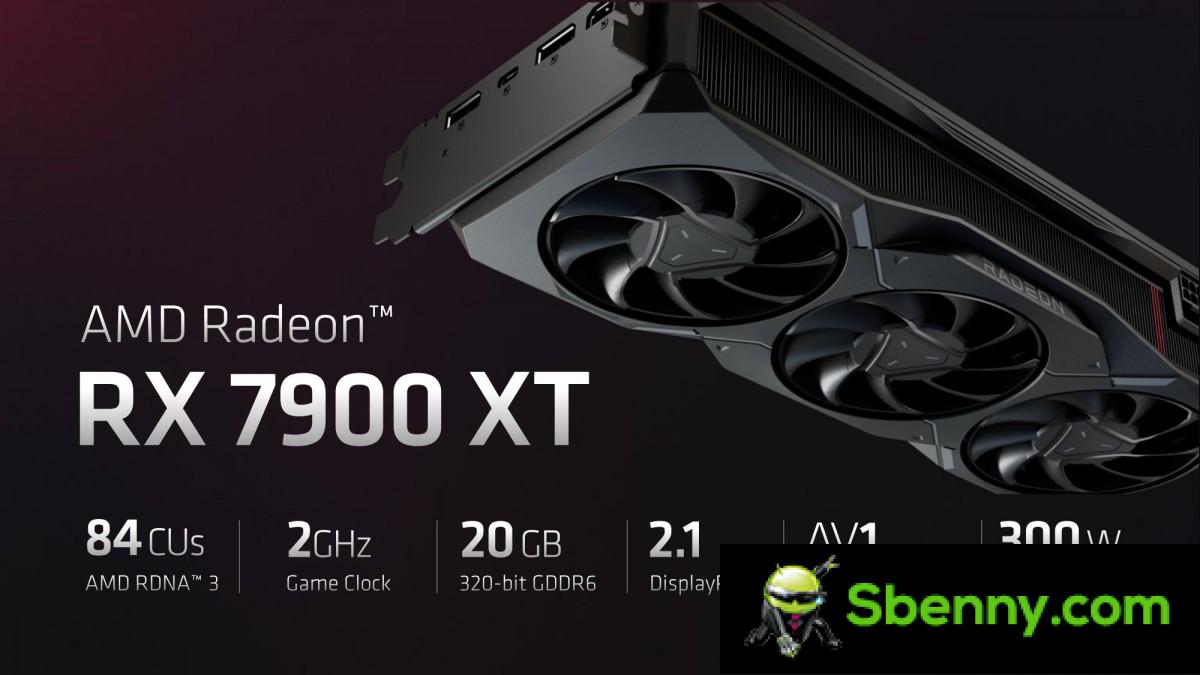
Meanwhile, the 7900 XT has 84 compute units, 2.0 GHz game clock, 20 GB 320-bit GDDR6 memory with 80 MB Infinity Cache, and a card power limit of 300 W.

Both cards support the new DisplayPort 2.1 standard limited to the intermediate UHBR 13.5 bandwidth of 54 Gbps, as well as a new media engine with simultaneous encode / decode for AVC / HEVC and 8K60 AV1 encode / decode.

AMD had surprisingly few first-party benchmark scores to show this time around. The 7900 XTX is said to be up to 1.7x faster in pure rasterization and up to 1.6x faster in 4K ray tracing than the 6950 XT. No numbers were provided against the competition or for the 7900 XT.
The 7900 XTX is priced at $ 999 and the 7900 XT is priced at $ 899. They will be available on December 13th.


Start a new Thread