
A court in Bogota, Colombia has granted Ericsson a preliminary injunction against Apple, which prevents Cupertino and its subsidiaries and partners from importing, selling and even advertising certain iPhones and iPads with 5G connectivity.
This is the first big win for Ericsson after Apple and Apple renewed legal hostilities earlier this year. The topic concerns the licensing fees for some essential standard patents (SEPs) related to 5G. Apple accepts the patents are valid, but believes Ericsson is overloading them.
This preliminary injunction (which Apple is appealing, of course) means that sales of the iPhone 12 and 13 series, as well as the new iPads with 5G, must be stopped in Colombia. The judge also informed the local customs authority to block imports of those same products, and Apple is required to contact online and offline stores and social media platforms to stop selling and advertising iPhones and iPads already in stock. .
The Colombian court also granted an “anti-lawsuit injunction”. Put simply, this prevents Apple from trying to use a court in another country to pressure Ericsson to overturn the import and sale ban in Colombia (e.g. by asking a court in the United States to penalize Ericsson’s operations. in the United States).
Instead, Apple’s attorneys are asking for “anti-lawsuit damages” in the Eastern District of Texas, asking Chief Justice Rodney S. Gilstrap to decide that Apple should compensate Apple for any fees, fines, penalties and costs resulting from the Colombian court injunction. .
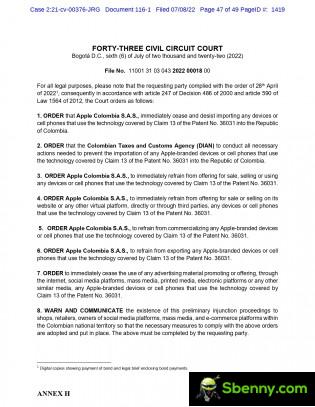

An English translation of part of the judge’s sentence in Colombia
Interestingly, Apple has tried to argue that there are no 5G networks currently available to consumers in Colombia and that “an injunction on an alleged patent for a 5G essential method cannot be enforced until a 5G network is activated. in Colombia “. However, the Colombian judge did not purchase it as phones and tablets could infringe the patent during tests of local 5G networks and as soon as a local carrier launches its next generation network. Trials started in 2020, the first 5G network in Colombia is expected to go live by the end of this year, so it’s not an unreasonable judgment.
Either way, Colombia is hardly a big market for Apple. But if this is only the first domino to fall, Apple could be in trouble and will have to pay Ericsson’s patent dues. Apparently, Apple pays less than $ 15 SEP royalties per phone, which is roughly 2% of the retail price of a new iPhone.
If you are interested in the legal details, please follow the link Source a FOSS patents. Author Florian Mueller also has a curious article about how Apple is self-righteous and accuses Ericsson of things it is doing on its own (e.g. it charges app developers a 15-30% commission for each app sold on the App Store).
Source | through


Start a new Thread