
The Snapdragon 8 Gen 2 launched with an unusual CPU configuration: 1 prime core, 2+2 performance and 3 efficiency cores. A Geekbench 6.1.0 scorecard has just surfaced and it shows that Qualcomm is ditching an efficiency core to add an extra performance core, and that the performance cores will run at different speeds.
It has 1x main core at 3.30GHz, then three performance cores at 3.15GHz, joined by two more running at a lower frequency of 2.96GHz, and finally two performance cores at 2.27 GHz. Here is a comparison table:
| Snapdragon 8 Gen 3 (speculative) | Snapdragon 8 Gen 2 | |
| First | 1 Cortex-X4 at 3.30GHz | 1 Cortex-X3 @ 3.2GHz* |
| Performance 1 | 3 Cortex-A7xx at 3.15GHz | 2 Cortex-A715 at 2.8GHz |
| Performance 2 | 2 Cortex-A7xx at 2.96GHz | 2 Cortex-A710 at 2.8GHz |
| Efficiency | 2 Cortex-A5xx at 2.27GHz | 3 Cortex-A510 at 2.0GHz |
| * 3.36 GHz prime cores on “for Galaxy” and 8+ Gen 2 chips | ||
Note that while the performance cores on the 8 Gen 2 were different (A715 and A710), they ran at the same frequency. The 8 Gen 3 runs the two clusters at different frequencies, it is not yet known if they have different cores. ARM has already unveiled the Cortex-X4, A720, and A520, so they’re the most likely candidates for the Gen 3 chip (unless ARM comes out with new designs between now and October 24th).
Core configuration 1+5+2 or better 1+(3+2)+2 follows the configuration that ARM had in mind when designing these cores. The X4 promises 15% higher performance for the same power or 25% higher efficiency for the same performance. Expectations were for the X4 to hit 3.4GHz, roughly where the “for Galaxy”/8+ Gen 2 chips are right now (their main core runs at 3.36GHz).
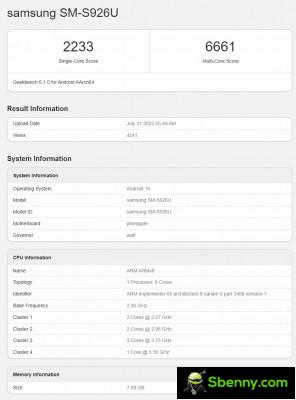
Geekbench 6.1.0 result from Samsung Galaxy S24+ (SM-S926U)
What about the rumor that Core Prime 8 Gen 3 will run at 3.7GHz? That will be impressive to see in a passively cooled battery-powered device, but even the new node (TSMC N4P instead of N4) may not be enough to pull it off. And judging by these benchmark results (admittedly very soon), Qualcomm and TSMC fell short of 3.7GHz.
There’s always the possibility that some performance mode may have limited the top speed (this is always a question with benchmarks that we haven’t run ourselves). Furthermore, it is not clear whether it is a chip “for Galaxy”: Samsung would have extended the agreement with Qualcomm also to next year.
Even otherwise, the increase over the Snapdragon 8 Gen 2 for Galaxy is quite considerable for a generation: +12% single-core and +26% multi-core for the new chip. The single-core performance still lags behind Apple’s A16 chip, but the multi-core score is ahead.
Of course, the Snapdragon 8 Gen 3 will have to fight the A17, not the A16, for the top spot in the performance chart. And Apple has bought nearly all of the 3nm capacity to build its chips, so it will have a node advantage.
Qualcomm is expected to introduce the Snapdragon 8 Gen 3 at the end of October, Samsung will introduce the Galaxy S24 series early next year.


Start a new Thread