
Look at your phone: it’s a rectangle with rounded corners, isn’t it? While this was established as the prevailing form early on, there were those who knew in their hearts that there are better, more natural forms.
In 2015 Monohm introduced the Runcible, described as an “heirloom smart pocket device”, this was both a smartphone and not a smartphone. And its circular shape cannot have escaped your attention.


Runcible Babbage • Runcible Lovelace
The Runcible had a round screen and a gently curved back, mimicking natural objects such as a smooth pebble. The theme of nature was supported by the choice of materials: from plastic recovered from the ocean to sustainable wood (Madrone, Black Acacia or Sinker Redwood). The backs were user-replaceable, and the company planned to use a variety of materials so you could customize your Runcible to your tastes.
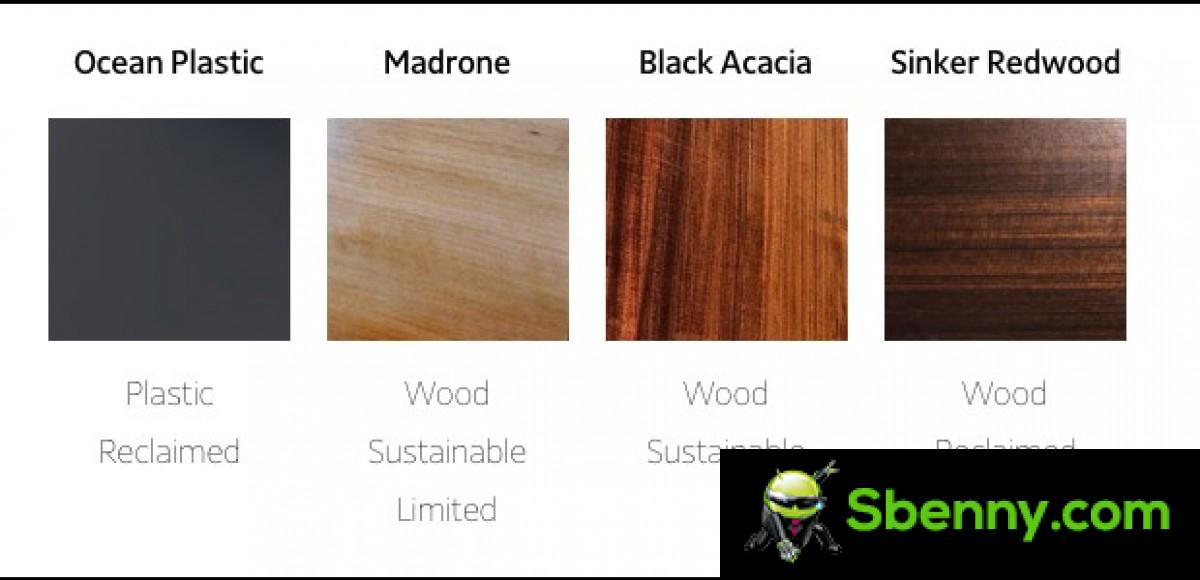
Recycled and sustainable materials for the Runcible
This was a little small for a phone, but too big to be part of the emerging smartwatch market. Instead, it was described as a “pocket watch” and with some of the accessories the design team had designed you could wear it just like one.
Even back in 2015, Monohm’s team was preaching the importance of digital wellbeing, something the big phone makers have only recently picked up on. The Runcible was designed to minimize distractions and to ward off addictive online networks.


The Runcible in its natural habitat: nature
But this was a phone, too, and you could do phone things: make calls via a Bluetooth headset (complete with a rotary dial, of course), send and receive messages, navigate to your destination (again using the round display to show a compass) and take photos (round photos, of course).
The Runcible had some really cool interface ideas. For example, even the bezel around the display was touch-sensitive, even the housing could track your fingers. All of this allowed you to swipe and swipe without locking the screen.
By the way, it was a 2.5-inch screen with a resolution of 640 x 640 px (256 dpi) with Gorilla Glass 3. It also had capacitive multi-touch, in fact, it was billed as the first round touch display.
After the 2015 introduction, Monohm’s team approached IndieGoGo in mid-2016 to finance production of the non-smartphone smartphone. Explaining what exactly that means is an intrinsic part of what this device was trying to be and (more importantly) what became of it.
The campaign ultimately raised $294,052 from 695 supporters. Here’s a look at the prices. Note that “Babbage” is the model with recycled plastic, “Lovelace” used Madrone wood and “Faraday” had a Sinker Redwood instead.

Okay, now we can talk about the non-smartphone smartphone thing. Initially, the team wanted to use Firefox OS. This fit well with their mission as they wanted Runcible to be different and the lack of apps (compared to Android) wasn’t a big deal as those were digital distractions anyway.
So the team went looking for a chipset that could run Firefox OS well, and they found one. Unfortunately, as Android Authority reported in 2016, the chipmaker discontinued it just as the Runcible project was getting off the ground. Then worst came to worst when Mozilla did away with Firefox OS in late 2015. No chipset, no OS. And now?

Note that all of this happened before the 2016 crowdfunding campaign, so the team found a way: despite avoiding it initially, they opted for Android. A highly customized version of Android called “BuniOS”.
BuniOS didn’t include the Google Play Store as Android apps couldn’t handle the round display. It could run apps (and Monohm recruited developers to make them), both native APKs and web-based apps. We’re not sure why Wear OS wasn’t an option, which natively supported round displays and had apps made for those displays.
It wasn’t so much the software that was the problem, however, creating new hardware is difficult, especially one as unique as Runcible. Eventually, hardware makers work with much larger orders, so they put Runcible on the back burner. Monohm tried to get extra funding but none was forthcoming.
The latest update arrived in May of 2019 and illustrates how difficult it is to do small-scale projects:
Our board maker, to produce less than 3000 boards for us, insists on charging almost double the price quoted per board. It’s very close to the same price to make 3000 boards as it is to make 1000. However, we only budgeted for 1000 boards at the prices quoted, and after trying different strategies, we can’t get them to change.
There has been no word on the Runcible since then, and any hardware and software work done on it would be obsolete by now, even for a non-smartphone. As with the original chipset, parts go out of production, then have to be replaced, then the whole thing has to be redesigned – it’s not something you can take back after 7 years.
What do you think of Runcible? Is a pocket smartwatch/non-smartphone/digital heirloom something you would like to have?
PS. If you’re interested, we could continue the round phone saga with the Cyrcle:


Start a new Thread