
Introduction and specifications
While the jump from the Pixel 6 series to the Pixel 7 series was rather modest, the launch of the 8 series is defined by a slew of new features and updated hardware. There’s also an interesting change in strategy with the smaller Pixel, the subject of this review. One of the most notable changes to this year’s vanilla Pixel 8 is its size. The Pixel 8 is now noticeably smaller than its predecessor, mostly thanks to the smaller 6.2-inch display, but other design changes have also helped reduce weight and size.
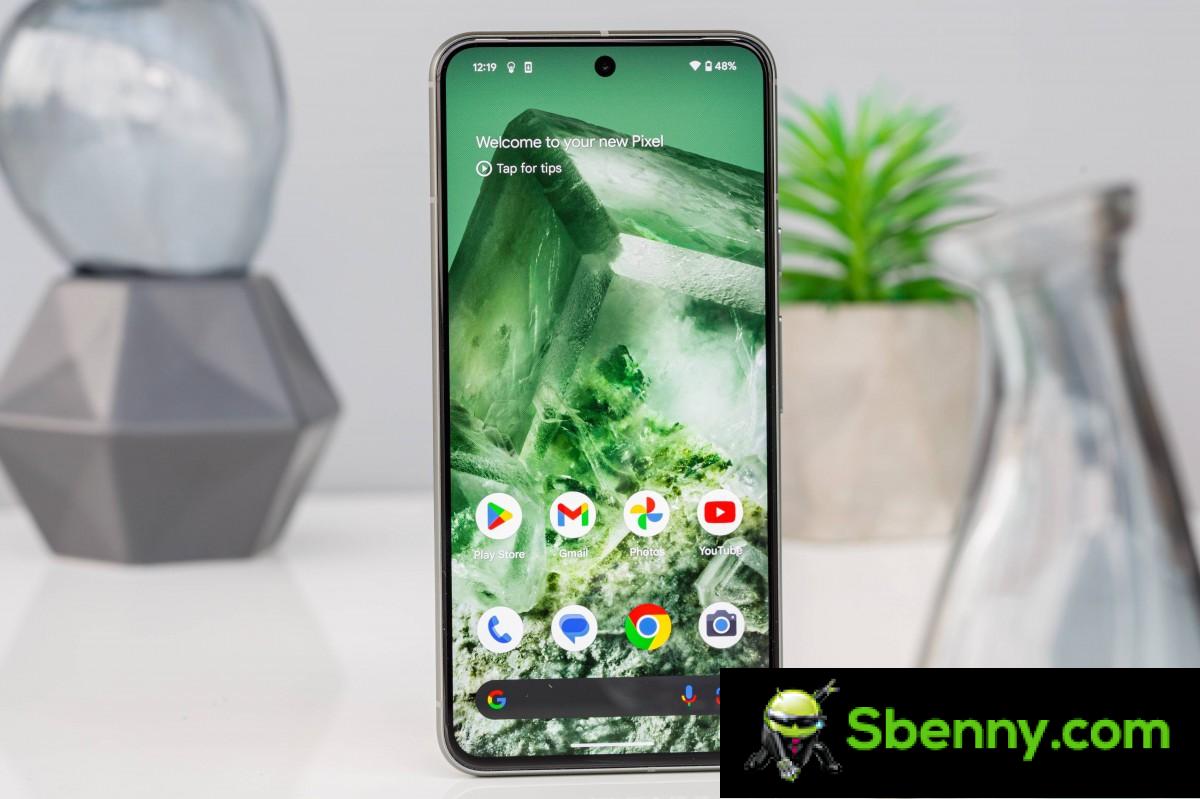
At the heart of the new Pixel 8 series is the new 4nm Google Tensor G3 chipset made by Samsung, which promises better efficiency and higher performance than its predecessors. It is also said to produce much less heat, which has been an issue for some users in the past. Added to the chip is Google’s Titan M2 security chip and an improved NPU, responsible for AI-related tasks.
The display department is also getting a lot of attention this year, and while Google’s Actua-branded LTPO OLED panel is reserved for the Pro, the Vanilla 8 offers a substantial upgrade over its predecessor. It’s not LTPO but it bumps the refresh rate to 120Hz (welcome to 2020, Google) and the display is advertised to hit 2,000 nits of peak brightness.
Google Pixel 8 specs in brief:
- Body: 150.5×70.8×8.9mm, 187g; Glass front (Gorilla Glass Victus), glass back (Gorilla Glass Victus), aluminum frame; IP68 dust/water resistant (up to 1.5m for 30 minutes).
- Screen: 6.20″ OLED, 120 Hz, HDR10+, 1400 nits (HBM), 2000 nits (peak), 1080×2400 px resolution, 20:9 aspect ratio, 428ppi; always active display.
- Chipsets: Google Tensor G3 (4 nm): Ninth-core (1×3.0 GHz Cortex-X3 and 4×2.45 GHz Cortex-A715 and 4×2.15 GHz Cortex-A510); Immortalis-G715s MC10.
- Memory: 128GB 8GB RAM, 256GB 8GB RAM; UFS3.1.
- Operating system/software: Android 14.
- Rear camera: Wide (main): 50 MP, f/1.7, 25 mm, 1/1.31″, 1.2 µm, multi-directional PDAF, laser AF, OIS; Ultra wide angle: 12 MP, f/2.2, 126, 1/2.9″, 1.25μm, AF.
- Front camera: 10.5 MP, f/2.2, 20 mm (ultrawide), 1/3.1″, 1.22 µm.
- Video Capture: Rear camera: 4K at 24/30/60 fps, 1080p at 30/60/120/240 fps; gyroscope-EIS, OIS, 10-bit HDR; Front camera: 4K at 24/30/60 fps, 1080p at 30/60 fps.
- Drums: 4575mAh; Wired 27W, PD3.0, PPS, 50% in 30 minutes (advertised), wireless 18W, reverse wireless.
- Connectivity: 5G; eSIM; Wi-Fi 7; BT 5.3, aptX HD; NFC.
- Various: Fingerprint reader (under display, optical); stereo speakers.
The camera system has always been a core feature of Pixel phones, and the 8 series is no exception to the rule. While there are no changes in the main camera, which isn’t a bad thing because the 50MP f/1.9, 1/1.31″ camera takes excellent photos, the ultrawide snapper is new. It’s still 12MP and not the ultrawide level of the 8 Pro, but it now supports autofocus, allowing for sharper overall photos and macro-level photography. Additionally, the lens offers a wider field of view.
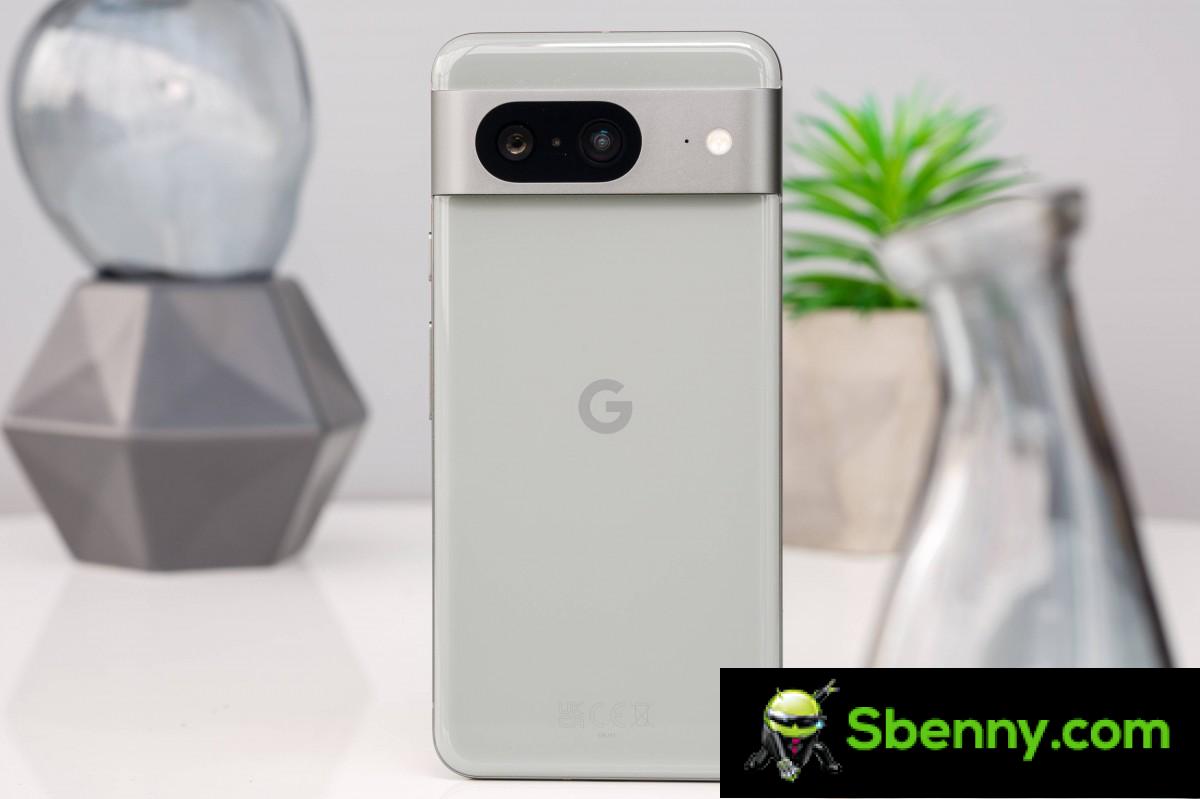
There’s also a modest increase in battery capacity, now 4,575 mAh. The cell supports 27W wired charging and 18W wireless charging, which is quite strange because that means a respectable upgrade in wired charging and a small downgrade in wireless charging. Last year, the Pixel 7 supported 20W wireless charging.
Last but not least, Google is stepping up its game when it comes to software support. Starting with the Pixel 8 series, Google promises 7 years of OS and security updates. This is more than any other smartphone manufacturer right now, even Apple’s latest iOS 17 is only available for iPhones that are no more than 5 years old.
While it all looks great on paper, the devil is in the details, so read on to find out how the Pixel 8 stacks up against the competition in various scenarios and whether the 8 Pro is worth the extra money over the vanilla 8.
Google Pixel 8 unboxing
The Google Pixel 8 ships in a modest retail box containing the bare essentials. It contains user manuals inside along with a USB-C to USB-C cable, ready for Power Delivery and a USB-C to USB-A adapter, in case you need it for charging or data transfer.

As is usually the case with some phones today, the charger isn’t included, so you’ll need to get a 27W or faster PD-capable charger.


Start a new Thread