
Huawei just announced its P60 series of phones with three entries. There is the vanilla Huawei P60, the Huawei P60 Pro, and the Huawei P60 Art, which brings a more avant-garde design to the series.


Huawei P60, P60 Pro and P60 art
All three phones share the same core hardware: 6.67-inch LTPO OLED screen with FHD+ (1220×2700 px) resolution and 1-120Hz refresh rate. The panel is protected by Kunlun glass and sports an integrated fingerprint scanner.

The cameras are the strong point of the P60 series, so let’s shift our focus for a bit. All three phones share the same 48MP primary camera with RYYB sensor and OIS. The sensor offers a ten-speed f/1.4-f/4.0 variable aperture with automatic scene-based switching.

This approach should capture the optimal amount of light, depending on the shooting environment. Huawei’s marketing materials praise the light-capturing capabilities of the new RYYB sensor as an industry leader. The main cam also supports up to 4K video recording.

Moving on to the ultrawide sensor: P60 and P60 Pro share the same 13MP unit with f/2.2 aperture while P60 Art gets a 40MP sensor with the same aperture. Next up is telephoto: The P60 offers a 12MP telephoto module with f/3.4 aperture, OIS, and 125mm equivalent lens. The P60 Pro and P60 Art get fancier 48MP telephoto modules with OIS and a 90mm equivalent lens capable of 3.5x optical and 100x digital zoom.
The telephoto lens on the P60 Pro and P60 Art has an aperture of f/2.1, which should perform much better in night shots than competing modules from other manufacturers. Huawei claims that its new 48MP telephoto lens can capture the largest amount of light in the industry, which is a pretty bold claim. The sensor also features three-axis stabilization

The P60 series is equipped with Huawei’s XD Fusion Pro texture engine, which strives to reproduce the textures of objects as close as possible to the way they are perceived by the human eye.
All three P60 phones feature the Snapdragon 8+ 4G chipset, an LTE-only version of last year’s Snapdragon 8+ Gen 1 SoC.
Another notable feature of the P60 series is the ability to send and receive Beidou satellite messages. You can send and receive text messages when there is no ground signal around. This feature will be limited to China.

The Huawei P60 and P60 Pro carry 4,815mAh batteries with 66W wired charging on the vanilla model and 88W on the Pro. Both versions also support 50W wireless charging. The P60 Art packs a slightly larger battery capacity at 5,100mAh and the cell is silicon-carbon, providing a higher energy density than its lithium-ion based counterparts. All three phones run Harmony OS 3.1 and are IP68 rated.
The Huawei P60 and P60 Pro are available in Feather Purple, Feather Black, Emerald Emerald and a limited Rococo White option. P60 Art is available in Blue Sea and Quicksand Gold colours.
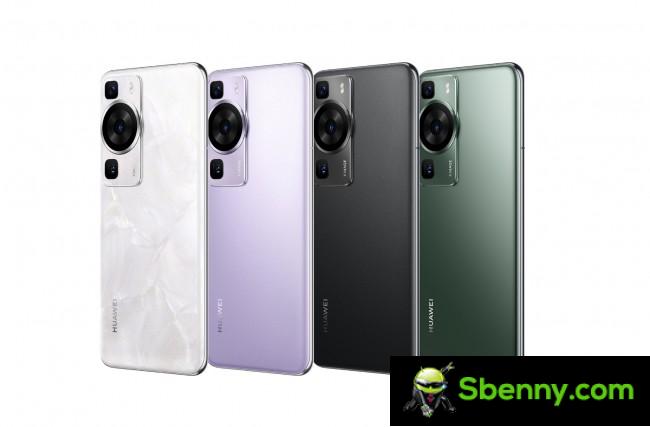
Huawei P60 and P60 Pro color options
Prices for the P60 start at CNY 4,488 ($657) for the base 128GB version and go up to CNY 5,988 ($877) for the 512GB model.
The P60 Pro starts at CNY 6,988 ($1,023) for the 256GB model and CNY 7,988 ($1,170) for the 512GB version.
The P60 Art is available in two versions: 512GB for CNY 8,988 ($1,316) and a 1TB model for CNY ($1,610).

Color options Huawei P60 Art
Open sales for P60 and P60 Pro in China start on March 30th. Huawei P60 Art will be available from April 7th. International pricing and availability will be detailed at a later date.


Start a new Thread