
Oh, the age-old clash between glossy and matte displays: a topic that sparks more late-night forum firestorms than a viral tech rumor.
In the glossy world of smartphones, it’s like finding a unicorn when a manufacturer dares to deviate. Enter the rare sight: the TCL 40 NxtPaper 5G with its matte LCD. It’s not just a phone; it’s a “what if” wrapped up in an elegant pocket-sized package.
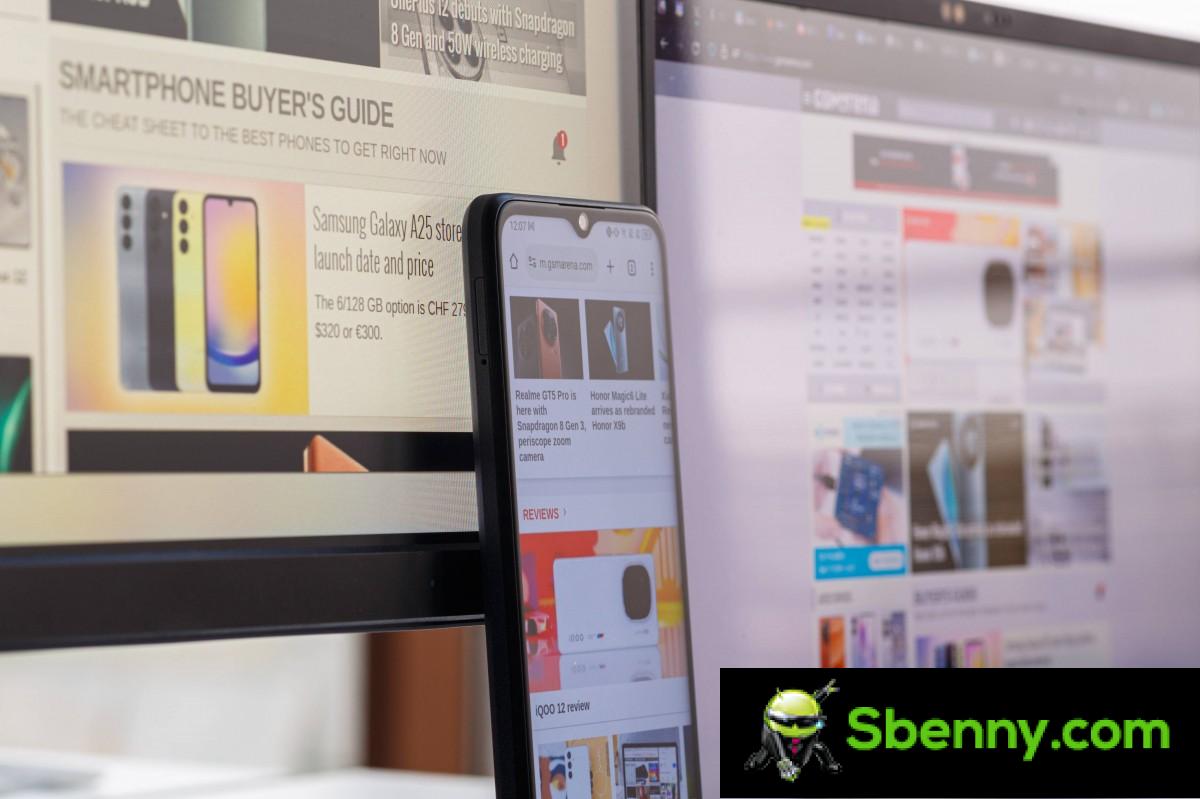
It seems that the world of smartphones has settled on glossy displays, so we no longer have a choice, right? We don’t even know if having a matte display on your phone is more appealing, unlike laptops or monitors where you can see both options in real life and decide for yourself.
The TCL 40 NxtPaper 5G is here to lift that veil for us. Let’s dive into this rare gem and see what it’s like to break free from the glossy norm and if it’s something we’ve all been missing.
What makes TCL 40 NxtPaper 5G special?
The TCL 40 NxtPaper is an experimental device – an attempt to offer a paper-like screen in a smartphone. It’s in color if you want it to be; It can also play videos. But switch to the right mode and it looks like a Kindle screen (ok, almost). Our point is that it’s great for both media and book reading. In doing so, however, it is far from exceptional at either. Before I explain, here’s an update on the phone’s specs.
TCL 40 NxtPaper 5G specifications in brief:
- Body: 164.5×75.4×9.0mm, 192g; plastic back.
- Screen: 6.60″ LCD, 90 Hz, 500 nits, 720×1612 px resolution, 20.15:9 aspect ratio, 267ppi.
- Chipsets: Mediatek Dimensity 6020 (7 nm): Octa-core (2×2.2 GHz Cortex-A76 and 6×2.0 GHz Cortex-A55); Mali-G57 MC2.
- Memory: 256GB 6GB RAM; microSDXC (uses shared SIM slot).
- Operating system/software: Android 13, TCL UI.
- Rear camera: Wide (main): 50 MP, f/1.8, 1/2.76″, 0.64μm, PDAF; Macros: 2MP, f/2.4; Depth: 2MP, f/2.4.
- Front camera: 8 MP, (wide), 1/4″, 1.12μm.
- Video Capture: Rear camera: 1080p@30fps; Front camera: 1080p@30fps.
- Drums: 5000mAh; Wired 15W.
- Connectivity: 5G; Hybrid dual SIM; WiFi 5; BT5.1; NFC; FM Radio; 3.5mm socket.
- Various: Fingerprint reader (side-mounted).
Starting from the beginning – what is the display technology used by TCL 40 NxtPaper 5G? The officially published specifications are vague at best, so they can easily confuse someone, whether intentionally or not.
The phone’s official marketing calls its display a “Color electronic paper display”. This immediately brings out associations with e-Ink display technology as seen in e-book readers like the Amazon Kindle line.
If you’re not familiar with the technology, it’s incredibly fascinating and involves real particles moving back and forth through capsules in different layers of the display to produce an image. Sometimes even in color. This image is then semi-permanent and does not require electricity to remain on the display, nor does it technically require a backlight to be adequately visible. To set the record straight, this phone doesn’t have that kind of display.
To make things even more confusing, in the past, TCL demoed e-Ink-based products under the NxtPaper brand, so they definitely had us as “Color E-Paper Display” in the beginning.

Our best guess is that the TCL 40 NxtPaper 5G uses an LCD with some clever additional layers on top, allowing it to produce a good-looking monochrome image to match the sublime matte finish. This finish feels really great under the fingers even though it’s nowhere near paper-like.
Glare and reflections
There are many ways to achieve a matte look, and not all matte displays have the same level of matteness. Typically, a traditional matte display will have an opacity value of 24-28%. Its purpose is to disperse light from the surrounding environment and diffuse it instead of reflecting it back to the user. The light still has to go somewhere, so it is scattered rather than reflected. Essentially, you’re trading direct reflections for light scattering.
This brings us to Reason 1 why you don’t want a matte display on your phone. A matte display like that of the TCL 40 NxtPaper 5G doesn’t have the same optical clarity as glossy ones.
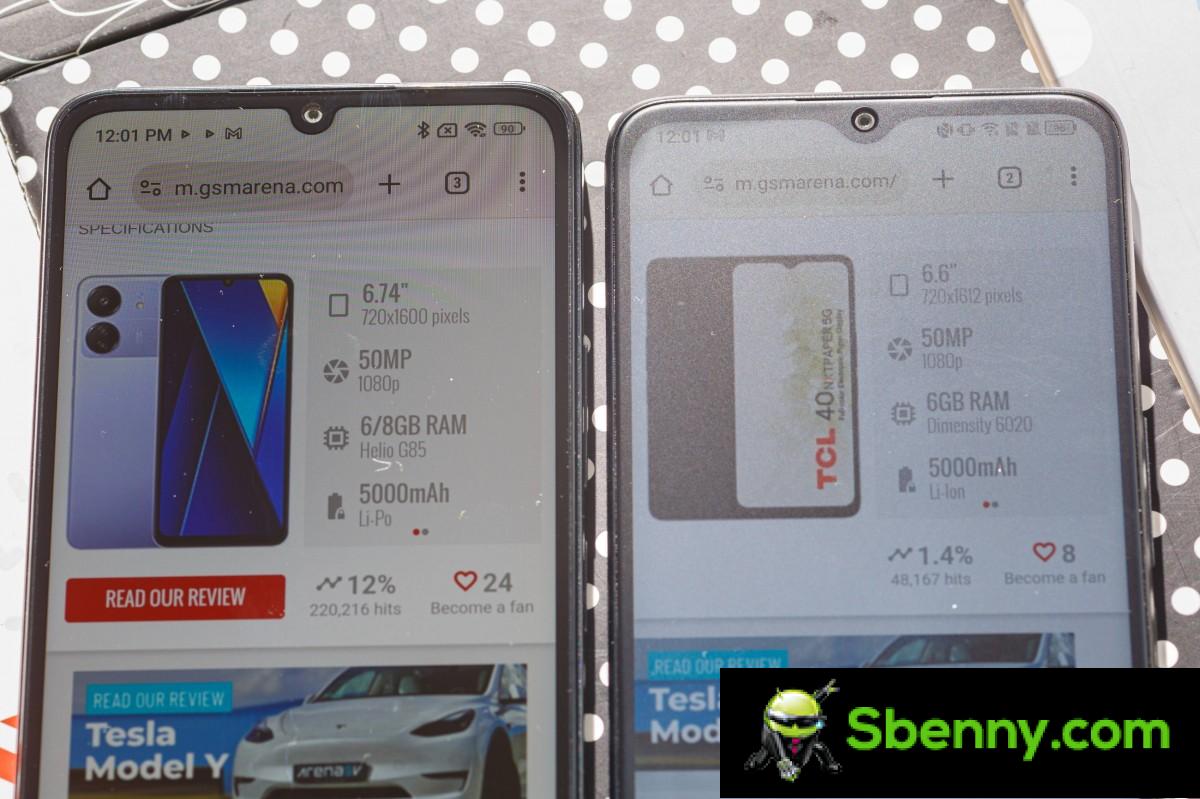
This also applies to the TCL 40 NxtPaper 5G. Its color palette is overall quite muted. None of the color modes are particularly color accurate. They all seem to target the sRGB color space but fail to achieve accurate reproduction with deltaE values up to ten and a noticeably cool, blue hue.
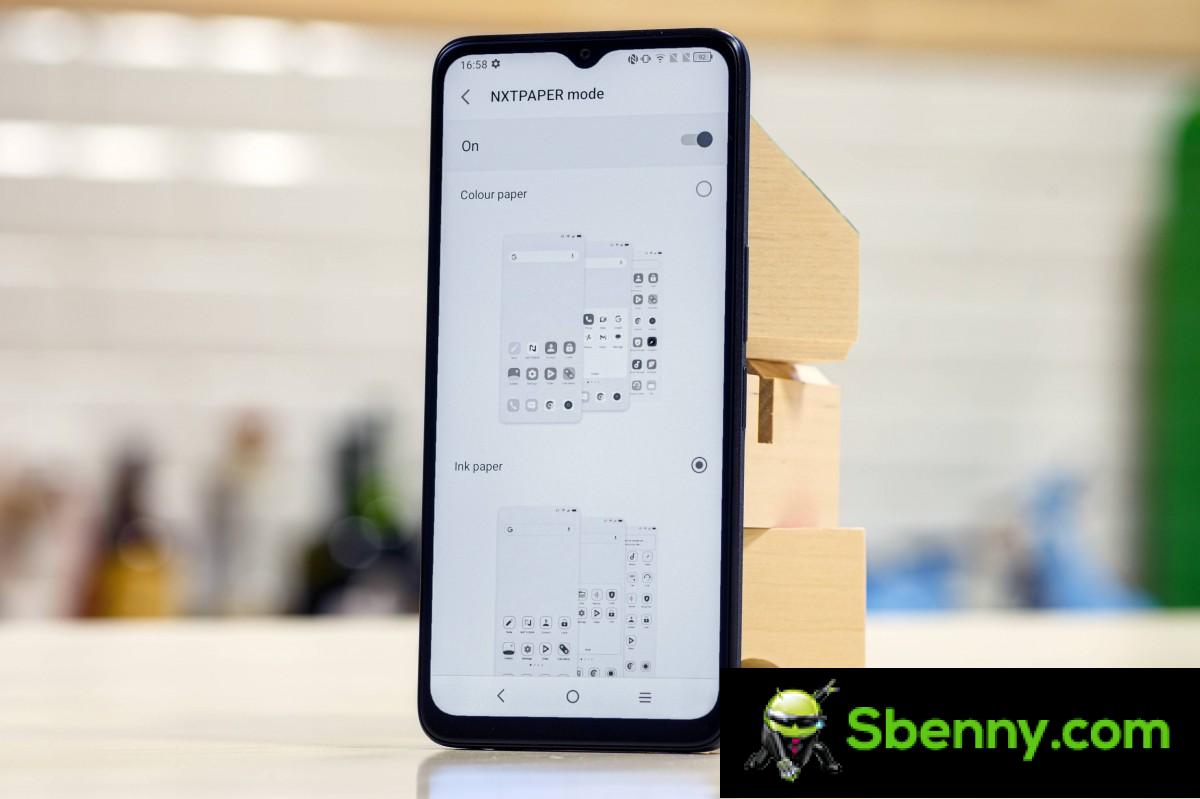
However, the really interesting color modes are housed within its own NxtPaper mode menu and are TCL’s attempt to mimic the look of an e-Ink display. As the name suggests, colored paper mode has colors, although these are incredibly muted, even more so than normal display color modes. The contrast is also particularly low.

Next among the NxtPaper modes is the Ink Paper mode, which is completely monochrome and has a fairly white and neutral backlight color.
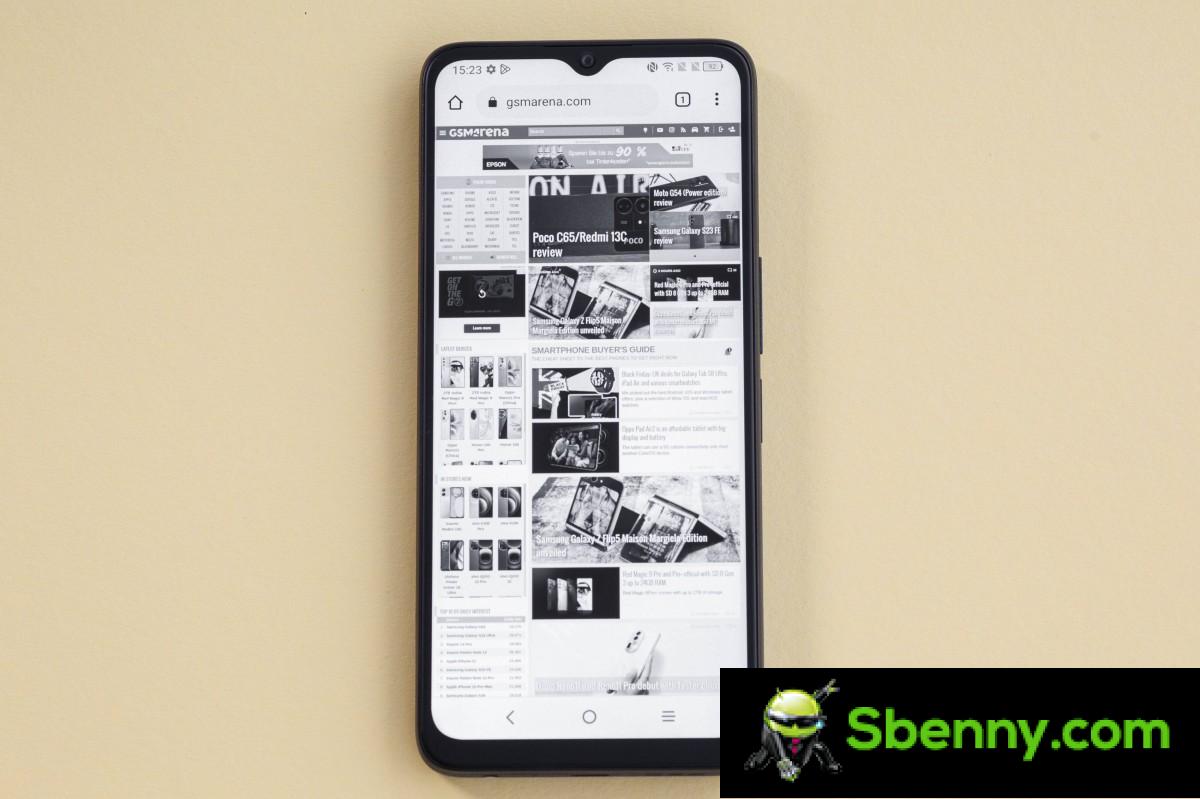
We have to say that at least at first glance, one could easily mistake the LCD for an e-Ink unit with that well-crafted monochrome mode with a nice white backlight and this matte display, which itself is an achievement from TCL. TCL claims that all of this is done to make reading easier and strain the eyes. Although we cannot guarantee that the TCL 40 NxtPaper 5G does not yet have a display thickness in the backlight or excessive blue light, we can say that subjectively one feels a little more comfortable looking at the display and especially reading on it, compared to a conventional glossy LCD.
But as explained above, this comes at the expense of color reproduction. You don’t plan on using your phone in monochrome mode all day, right?
Image clarity
Image sharpness is another common problem with matte displays. This is mainly due to the fact that the matte surface disperses and diffuses both the light coming from the surrounding environment and that coming from the display itself. This means that due to refractions of light, straight lines simply don’t look as straight and are instead a bit “blurred”. This is especially noticeable on smaller text fonts and isn’t ideal for something marketed as a reading-focused device.
And this brings us to reason 3 why you don’t want a matte display on your phone. It just doesn’t look as sharp as a glossy screen.

Display sharpness comparison
Matte surface grain is particularly annoying on solid colors. It doesn’t help much that the resolution of the TCL 40 NxtPaper 5G is only HD+ (720 x 1612 pixels). This is relatively thin on a 6.6-inch 20:9 diagonal, which translates to a pixel density of around 267 ppi. Perhaps the 4G version of the phone will look a little nicer given that it has an FHD+ display instead.
Final thoughts
While this is certainly a nice tidbit, we can’t see ourselves recommending a matte-screen phone to the casual user and that extends to include the TCL 40 NxtPaper 5G. The matte display looks impressive in its own right, but in our opinion it doesn’t offer enough benefits to outweigh the technology’s various drawbacks. Also, overall, the phone itself isn’t particularly impressive.

We don’t really think matte displays will become a thing anytime soon, and for good reason. As we see it, the current approach of combating glare and reflections by pushing higher brightness levels, in addition to modern anti-reflective coatings, is much better overall. You get much more vibrant colors, much better contrast, and overall sharpness on a glossy display, all of which are arguably more valuable to consumers.


Start a new Thread