
Numerous upgrades to the camera system, a brand new super bright display, next-gen custom chipset, and 7 years of software support – as generational improvements go, the Pixel 8 Pro seems to offer much more than the bare minimum. Last year’s 7 Pro was already a fairly powerful phone, and it may still be the best option for those looking for a high-end Google Phone experience at a lower price than the latest flagship. Let’s see how the two compare.
Summary:
To get started, you can compare the full spec sheets here or check out our editor’s rating in the text below.
Size comparison
The numbers in the size and weight section of the spec sheet won’t help you decide between the two. The single gram that divides them makes no difference, exceeding 210 grams each, and even fractions of a millimeter in this or that direction normally go unnoticed. But that’s not to say that the two phones aren’t physically different enough to at least be so Some meaning.
Perhaps the most important distinction comes at the front, where the Pixel 8 Pro has a flat display, unlike the curved edges of the 7 Pro. While the latter is more attractive, the 8 Pro is more practical: it can accommodate a protector for most glass screen and is less likely to pose handling problems (vocal opposition to a curved screen is still a thing). Beyond that, the switch from last year’s glossy glass to frosted glass on the 8 Pro means fewer (or rather none) fingerprints, though it’s probably a little more slippery.
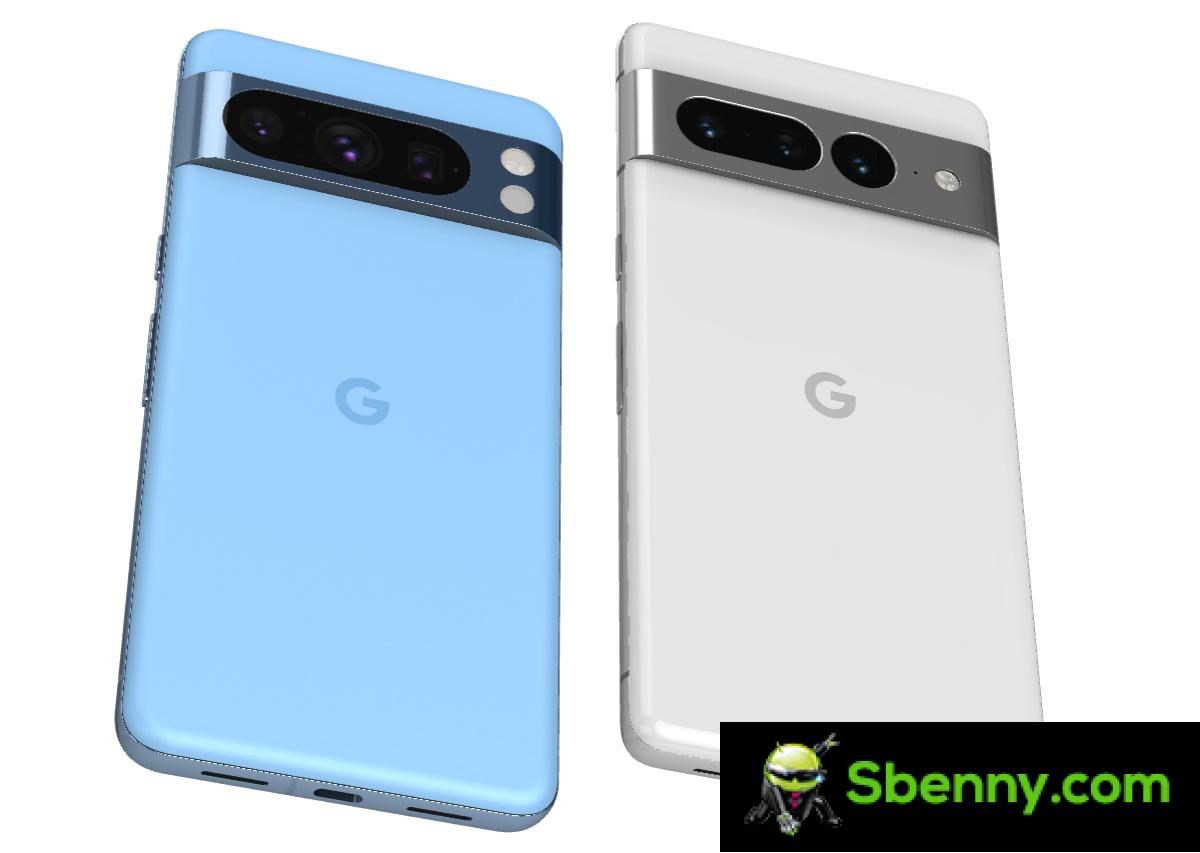
The Pixel 8 Pro gets upgraded protection, and in the unlikely event of a drop, its Gorilla Glass Victus 2 might perform slightly better than the first-gen Victus on the 7 Pro. Both phones are IP68-rated, so no advantage for neither on this.
Depending on where you stand with color preferences, each generation has something to offer. The 8 Pro’s Bay is undoubtedly our favorite, but the 7 Pro is available in Snow (white), which is not available on the new model. Obsidian (black in layman’s terms) can be found on both, while Porcelain (8 Pro) and Hazelnut (7 Pro) offer softer alternatives.
View the comparison
Among the key developments in this year’s Pixel phones are new displays, and the Pixel 8 Pro’s Super Actua panel delivers on that promise. We measured 1,600 nits with adaptive brightness enabled, a significant improvement over 1,090 nits the 7 Pro is fine in the same conditions. Upon request, the new phone can also be super bright – 954nitscompared to the 7 Pro 588nits.
Brightness aside, the two displays don’t have much to distinguish them. Both support HDR10 and HDR10+, while Dolby Vision is not yet in the menu. Both panels have very accurate colors in one mode and equally vivid in the other.
The 8 Pro perhaps has an advantage in how the adaptive refresh rate is handled: it’s advertised as being able to go down to 1 Hz, and we’ve seen such readings from the built-in tool, while the 7 Pro’s supposed 10-120 Hz support doesn’t. it never reported anything below 60Hz.
Battery life
The Pixel 8 Pro gets a 1% increase in battery capacity this year, now at 5,050 mAh. In our Endurance evaluation tests, the new model posted higher numbers than the previous generation across the board, but not so high as to challenge major competitors.
While we don’t have an active usage score for the Pixel 7 Pro to give you another point of comparison between the two models, we’re confident in saying that the new model will have an advantage here too, just as not huge in magnitude. . In this sense, even if the 8 Pro is a step forward, battery life alone shouldn’t be a big enough advantage.
Charging speed
Google doesn’t compete with Chinese industry leaders in charging speed, but it isn’t the fastest against competitors from Apple or Samsung either. That said, the results obtained with the Pixel 8 Pro are a welcome step in the right direction, if not a “leap” in themselves.
Using Google’s official 30W charger, we clocked a full charge from zero to taking 1:23 hours on the Pixel 8 Pro – an improvement of nearly half an hour over the Pixel 7 Pro, admittedly glacial.
Likewise, at the end of 30 minutes, we are seeing an improvement compared to the previous generation.
Both phones support wireless charging, and Google specifies a maximum power rating of 23W with the Google Pixel Stand, while generic Qi-compliant pads will mean 12W max (if the pad itself supports the extended power profile). Given the improvement in wired charging speeds, however, we wouldn’t be surprised if the new model charges faster, but that’s just speculation on our part.
Test the speakers
There are no generational changes in the concept of speaker setup, and the Pixel 8 Pro has the usual hybrid arrangement used by the 7 Pro: a “main” unit that comes out of the bottom of the phone, joined by the earpiece acting as a second channel. The top speaker will be assigned the left channel vertically, while horizontally the channels will be adjusted to match the actual orientation. Regardless of orientation, each speaker will output the file as well other the channel trace as well, albeit at an attenuated level.
In our test, the Pixel 8 Pro earned a “Good” rating for volume, a level lower than the 7 Pro. To our ears, however, the 8 Pro has superior output, offering a more balanced sound than the old model, with some good low end hits, clear vocals and well defined highs.
You can compare the sound of the two phones under controlled acoustic conditions with the samples below. Just make sure you have headphones on and the volume is turned up.
Performance
Featuring a custom chipset for the third year in a row, Pixel 8 Pro is powered by the Tensor G3. Based on Samsung’s 4nm manufacturing process, the SoC is equipped with an unusual 9-core CPU (1×3.0GHz X3 & 4×2.45GHz A715 & 4×2.15GHz A510) and the Immortalis-G715s MC10 GPU.
The 7 Pro is based on the previous generation Tensor G2 chip and is made on a 5nm process. It features a more conventional octa-core CPU (2×2.85 GHz X1 & 2×2.35 GHz A78 & 4×1.80 GHz A55) and the Mali-G710 MP7 GPU.
All versions of the Pixel 8 Pro come with 12GB of RAM. When it comes to storage, the very existence of a base 128GB version seems wrong, but at least you get more options: 256GB, 512GB, and 1TB. Pixel 7 Pro, however, starts from 8 GB/128 GB and reaches a maximum of 12 GB/512 GB.
When Google took over designing the chipsets for its phones, it made it abundantly clear that it wouldn’t be chasing records in benchmarks and raw performance. Neither the Pixel 7 Pro nor the Pixel 8 Pro are truly competitive against rivals of their respective generations, but the 8 Pro is, after all, more powerful than the 7 Pro – up to 15% in CPU tests and up to 30% in graphics benchmarks .

Google
Pixel 8Pro
AnTuTu 10
1,151,243
Geekbench 6
1,766 single-core
Geekbench 6
4,492 multicores
Google
Pixel 7Pro
AnTuTu 10
868,627
Geekbench 6
1,489 single cores
Geekbench 6
3,937 multicores
Somewhat difficult to quantify are the perception of fluidity, the usefulness of the artificial intelligence that only Google offers, the speed of software updates and long-term support. In this sense, the two phones aren’t all that different, even if the new model promises seven years of software support. However, it is likely that you will have replaced your Pixel before that period expires.
Camera comparison
The Pixel 8 Pro continues in the footsteps of the previous generation with its camera system, offering a trio of cameras on the back. There are several key improvements in the hardware, however, including a brighter lens on the main camera, an all-new large-sensor ultrawide camera with autofocus, and a revamped telephoto lens that’s slightly shorter, but also brighter. The selfie camera is also updated and now features autofocus.
Photographic quality
During the day, the new model brings small improvements in terms of detail on both the main and ultrawide cameras – hardly revolutionary things, but the differences are there if you look (very) closely. Likewise, there’s not much improvement in 5x zoom shots in broad daylight (or whatever this gloomy weather was). In any case, the overall look of the images contains the characteristic Pixel quality, so both models will put you in the #teampixel.






Daylight examples, Pixel 8 Pro: 0.5x • 1x • 2x • 5x








Daylight examples, Pixel 7 Pro: 0.5x • 1x • 2x • 5x
In low light, things get a little more nuanced. The new model’s ultrawide has the upper hand in terms of detail and noise performance, and the telephoto is slightly sharper too. The main camera also tends to produce slightly cleaner shots.








Low-light samples, Pixel 8 Pro: 0.5x • 1x • 2x • 5x








Low-light samples, Pixel 7 Pro: 0.5x • 1x • 2x • 5x
One of the new features of Pixel 8 Pro is the introduction of autofocus on the front camera. While selfies look about the same at arm’s length (aside from a slight difference in white balance), the 8 Pro’s selfie camera’s ability to focus closer allows it to capture a few more angles. .. interesting. Buying the new model is the best idea if you like selfies.




Selfie examples: Pixel 8 Pro • Pixel 7 Pro
Video recording
Both the Pixel 8 Pro and 7 Pro can record video at up to 6K60 with all four cameras, and you can also choose to shoot in 4K24 in addition to the “normal” 4K30.
The new model’s ultrawide camera captures noticeably sharper footage in daylight, and we’re willing to forgive it for its slightly unbalanced white balance. The 8 Pro also offers the best performance when comparing main cameras, both at native focal length and at 2x zoom. It’s a similar story for telephoto lenses too, where the 8 Pro’s clips are higher quality.




Screenshots, 4K video in daylight, Pixel 8 Pro: 0.5x • 1x • 2x • 5x




Screenshots, 4K video in daylight, Pixel 7 Pro: 0.5x • 1x • 2x • 5x
In the dark, the 8 Pro holds the upper hand over all three cameras, and while the differences aren’t as pronounced, the new model’s superiority is undisputed.



Screenshots, 4K video in low light, Pixel 8 Pro: 0.5x • 1x • 2x • 5x


Screenshots, 4K video in low light, Pixel 7 Pro: 0.5x • 1x • 2x • 5x
Here’s a glimpse of how the Pixel 8 Pro’s main camera compares in image quality to that of the Pixel 7 Pro in our photo comparison tool.
And here’s how the video quality of the Pixel 8 Pro’s main camera compares to that of the Pixel 7 Pro in our video comparison tool.
Verdict
The Pixel 8 Pro represents a relatively significant generational step for the series that may not bring dramatic changes but it still improves in key areas and the improvements are worth it. The slightly modified main and telephoto cameras, new ultrawide, and added AF functionality on the selfie unit make an already versatile camera system even better in many ways.
The new Super Actua display is among the brightest on the market, and the old one was super too quite good, this is really cool. Small improvements in battery life and charging speed also help make the new model an even more complete package. Long-term support will also appeal to a certain type of consumer, though it’s not like the 7 Pro will be denied updates anytime soon.
As for the 7 Pro, although it is still available alongside the 8 Pro, its main selling point over the new model is its lower price. The difference in MSRP in the US is only $100, making the 8 Pro definitely the better deal. In Europe, you’d see a saving of €200, which makes a little more sense, but it still seems like the 8 Pro is worth the premium. With the shopping season upon us and production of the 7 Pro halted, however, several discounts could help better support the 2022 model.
- The brightest and flattest display.
- Better battery life and charging speed.
- Overall camera performance has improved.
- Even longer software support.
Get Google Pixel 8 Pro for:

- The lowest price.
- The most sophisticated look of the curved screen.


Start a new Thread