
Today let’s take a look at the June moon. From a meteorological point of view, the month of May was rather mild, with rainfall and temperatures in the average for the period, except in the last part of the month which saw the arrival of the great heat. The spring-summer gardens are for the most part started and in June those who are late will try to recover, considering also that the climatic changes in progress, move the seasons of the outdoor garden up to the autumn months. So we are not afraid to start our organic crops now. For those who have already started cultivating the vegetable garden, this is the time to devote themselves to the work of caring for vegetables. For example, we will proceed with the arrangement of the different ones types of mulchto the protection of the garden with anti-hail netsto the stakes for the crops that need them, to the bindings, without forgetting the biological antiparasitic defense.
The phases of the moon for June 2022

Let’s get right into the discussion by illustrating the phases of the moon in June 2022.
The last new moon was on May 30th, therefore the month of June opens with a waning moon phase, until day 13. The first quarter takes place on June 7th. The full moon is instead scheduled for day 14 and begins the waning (missing) moon phase. The last quarter of the lunar cycle takes place on June 21st.
The month of June closes with the new moon (novilunio) on June 29, which starts a new growing phase of the lunar cycle.
In summary then we will have:
-
- The crescent moon phase runs until June 13
- That of the waning moon from 14 to 28 June
- A new phase of the waxing moon starting on June 29th
The solar calendar of the month of June
The month of June is the one with the longest days of the year, that is, with the greatest number of hours of light. This allows us to stay late to work in the garden, and the work, in this period, is never lacking.
At the beginning of the month, day 1, the sun rises at 5.38 and sets at 20.38, so we have 15 hours of sunlight available.
Summer solstice
In this month the summer solstice, that is, day 21, we pass from spring to summer. This is the longest day of the year, with sunrise at 5.35 am and sunset at 8.49 pm, therefore a total of 15 hours and 14 minutes of light (the times are relative to the latitudes of the city of Rome). The word solstice is of Latin origin, solstitiumand is formed by the two suffixes sol– (sun) and –sistere (stop). Translated into astronomical language, the solstice represents the moment in which the sun reaches the point of minimum or maximum declination, in the apparent motion that it makes along theecliptic. This phenomenon is produced by the degree of inclination of the earth’s rotation axis, with respect to the ecliptic, which represents the apparent path that the Sun makes in the course of a year with respect to the background of the celestial sphere.
Transplants of the month in the growing moon
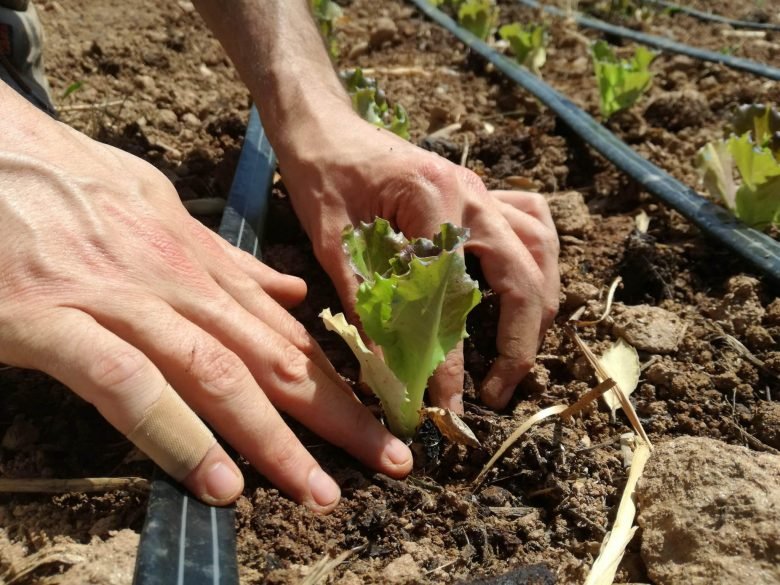
Lettuce transplant
Even during the month of June, transplants of the summer garden can be carried out. In recent months we have shown you which are the main crops of the season, which must be completed or started in June. Those who do the home garden, perhaps for the first time or due to contingent situations, will perhaps find themselves a bit late with the preliminary work (such as soil preparation or the irrigation system). It is therefore possible that the start period of cultivation begins in this month. As far as transplants are concerned, this only implies the postponement of the harvest period. In fact, June is the ideal month to plant the young seedlings of many crops. The most cultivated of the period are tomatoes, eggplant, peppers, chili Peppers, zucchini, cucumbers, chicory, parsley, basil, canasta lettuce. For the transplants we have just listed, it is always good to prefer the waxing moon phase.
The large sun exposure also allows you to make up for lost time, naturally accelerating the vegetative cycle.
Sowing in the crescent moon
For direct sowing the June moon must be waxing. Yes they can sow in postarelle: pumpkin, watermelons, green beans; or broadcast there rocket salad and in regular rows the corn ei sunflowers.
Sowing and transplanting in the waning moon
In the central part of the month we have the June moon in the waning phase. In these periods, conditions of greater humidity are created in the ground and the brightness of the moon is less. This shifts the plant’s life force towards the roots.
With the waning moon, therefore, it is good to transplant: onions And leeks. We will also plant rhizomes such as the turmeric or it gingerand we will broadcast: radishes, carrots And beetroot.
Jobs in June, watch out for irrigation

Irrigation system
Usually, in the month of June you start to feel the real heat. Temperatures, in some areas, easily exceed 30-35 degrees. This year, the rainfall of the spring months was abundant, and the soils should be richer in water. With the arrival of heat, in any case, it is always good to guarantee the crops the right water supply and at the same time avoid stress.
Whether you use a drip irrigation system that a sliding one with furrows, remember to always give water in the cool hours of the day, possibly early in the morning, or towards sunset. Never give water during the hot hours, as the plants are subjected to water stress. This is due to the speed of evaporation caused by direct sunlight and heat. Another trick is, in general, to make our plants drink little, but on a regular basis. Avoid giving a lot of water at long intervals. In this way, water stagnation is avoided, which are very dangerous for the onset of rot or fungal diseases such aspowdery mildew and the downy mildew.
The care of the crops, the mulching
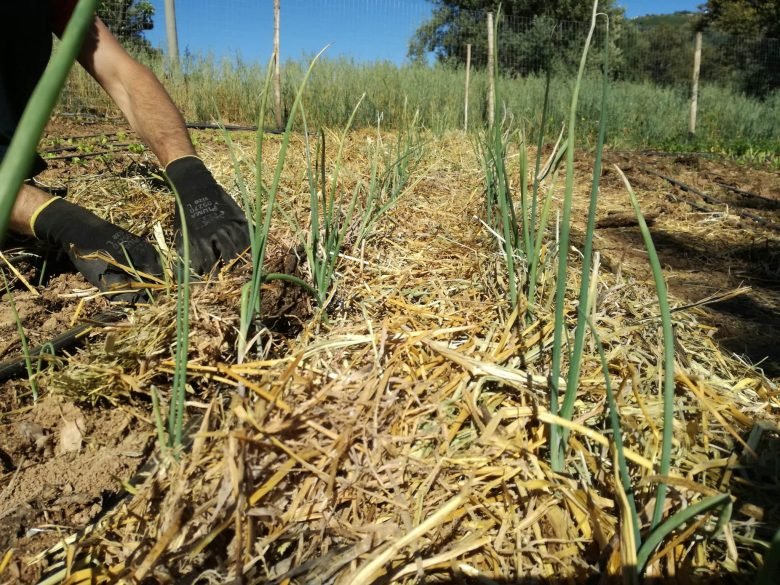
Mulch with straw
Let’s now see what are the main treatments for the crops in our garden. Among these, the first thing we recommend you to consider is the mulch, of course if you have the right material on hand. With this technique we have considerable agronomic advantages that should not be underestimated, especially in hot periods. These advantages are:
-
-
- The decrease in water needs, the soil under the straw remains more humid.
- The limitation of the need to eliminate weeds.
- The nourishment of the soil, thanks to the release of organic substance and the development of microorganisms.
-
For those who do not choose mulching, periodic must be carried out weeding worksin order to keep the vegetables clean from the excessive presence of weeds.
The arrangement of the stakes for the plants
Those who planted in May will now have to face the problem of supporting some crops. In the case of tomatoesfor example, it will be necessary to create a structure with wooden or bamboo poles (like these that found here), to which the plants will be linked, as they grow. In the case of crops such as i green beansbeans oi cucumbersnetworks will need to be set up (if you need the found here), which stretch out and are tied to wooden poles, so that the plants can develop by climbing, weaving their dense vegetation into the meshes.
Interventions on plants
Another work to be tackled in the period of June is that of technical interventions on the plants. Staying on the example of tomatoes, the works of defeminellatura. These are done by removing the lateral jets that limit the balanced growth of the plant and slow down the production and ripening of the fruits. With the side jets it is possible to start the preparation of the tomato macerate. Other work, if you have not already done it, is the very important one of tamping potatoes.
The preparation of macerates for biological defense

Horsetail plants
There are many natural macerates to prepare in June. That of tomato feminelle which we mentioned in the previous paragraph is an excellent remedy to counteract the cabbage. But thanks to the spontaneous herbs that are born in this period it is possible to prepare many others, which we will use if necessary for the biological defense of plants.
Around the countryside, for example, you can easily collect thehorsetailL’nettlethe fernL’absinthe. In the reported links you will find the recipe to prepare completely natural pesticides with these plants. These will allow you to defend your garden in a completely biological way. In fact, there are many parasitic insects that threaten crops in this period. As an example, we list some of them: aphids, white fly, altica, bedbugs, snails, oziorrinco, Colorado potato beetle, absoluta tomato suit.
Harvest of the month in the orchard
Finally, June is a very rich month for seasonal fruit. In fact, in this period we have the maturation of peaches and of apricotsof the Cherry treeof the mulberry blackberriesof the first plums, of the strawberries. Of course, you may not be lucky enough to have fruit trees in your garden. In this case, try to make informed purchases and always contact the organic producers of your area.



Start a new Thread