
Ray tracing is a major selling point for recent generations of desktop GPUs and consoles and has made its way onto mobile devices as well. ARM comes into action with a new line of GPUs, Immortalis. Mali does not go away, in fact, there are two new designs to be used in premium and mid-range smartphones.

Immortalis-G715 is the first ARM GPU to have hardware acceleration for ray tracing. Last year’s G710 might do it in software, but hardware support is literally a game changer – it only takes up 4% of the shader’s core area, but improves performance by over 300%.
Below is a demo showing the quality improvements in game graphics you can expect from ray tracing (see soft reflections and shadows). The first chipsets with Immortalis-G715 are expected in early 2023.
There is also a novelty Mali-G715 GPU ea Mali-G615. The main difference between the two are the base counts: 6 or less for G615, 7-9 for G715 (and 10 or more for Immortalis).

All three GPUs support Variable Rate Shading (VRS). This is a system that allows game developers to tell the GPU where to focus their efforts, making things full resolution (eg the player character) and where it can take shortcuts (eg background). When played correctly, the game looks the same to the player, but the frame rate can increase by up to 40%. Of course, this can also be used to significantly reduce power consumption, which is important on battery-powered smartphones.
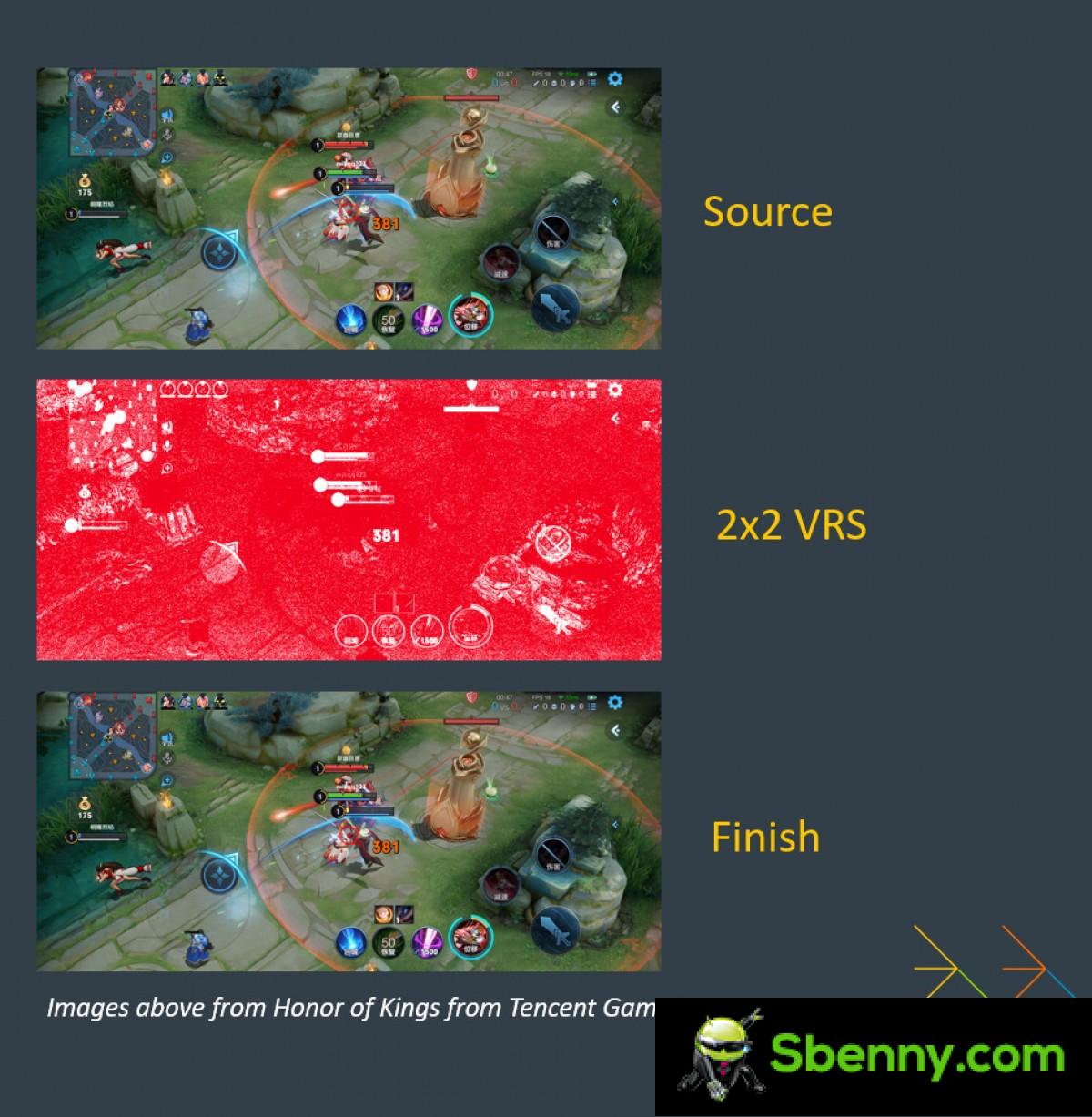
All three GPUs are also equipped with an improved execution engine, which will provide a 15% performance improvement, making them the fastest ARM GPUs to date.
A very common instruction is Fused Multiply-Add or FMA (think A * B + C). ARM managed to double the performance of FMA blocks by increasing their size by only 27%. One new feature is the Matrix Multiply instruction, which is the key to computational photography and image enhancement. The new GPUs offer twice the machine learning performance of their predecessors.

The company has made other improvements as well, including tripling triangular throughput and adding ARM Fixed Rate Compression (AFRC) for textures, which reduces bandwidth usage.
ARM is working closely with Unity and Epic, who build two of the most popular game engines on PC and mobile devices, to develop new graphics technologies. For example, ARM and Unity have developed the Adaptive Performance feature, which allows developers to set the game’s frame rate based on previous frames and device temperature.
Mobile games now account for 51% of the market and it’s a huge $ 100 billion deal. And with the prevalence of smartphones, most games are played on a mobile GPU, so it’s nice to see them adopt new features that are popular with desktop and console gamers.
The new GPUs will be paired with the new CPUs for upcoming chipsets. Already MediaTek congratulated ARM on launching its first hardware ray-traced GPU and we’re not trying to read things too much, but we’re excited about what’s to come next year.


Start a new Thread