
An early AnTuTu benchmark score showed that the upcoming MediaTek Dimensity 9200 chipset will bring an impressive improvement in graphics performance by upgrading to ARM’s new Immortalis-G715, its first ray tracing capable GPU. Now a couple of GFXBench results have surfaced and make the upcoming chip even more impressive as its scores outperform any current chipset.
This includes Apple’s latest A16 Bionic, although cross-platform comparisons aren’t always accurate even with the same benchmark. We also don’t know which device the Dimensity 9200 is using, but it appears to be running firmware that is still under heavy development. Digital chat station reports that the ES 3.1 results went from 176fps to 228fps with the latest iteration of the software (the AnTuTu test may have been run with the old software).

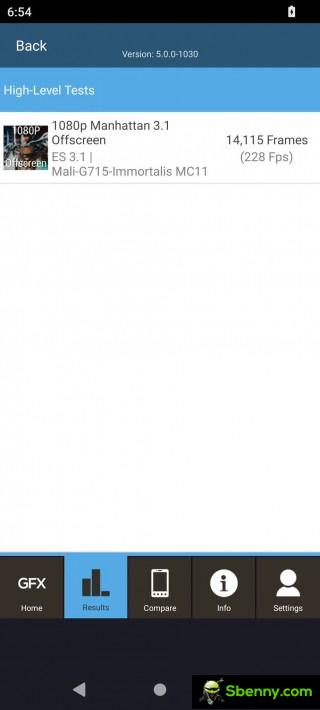
GFXBench results from a Dimensity 9200 device (1080p off screen): Manhattan 3.0 • Manhattan 3.1
The above results (published by Ice universe) are our first look at the performance of the new Immortalis-G715, a ray-tracking version of the Mali-G715. It sounds very promising, but this isn’t the right test for it – these versions of GFXBench don’t use ray tracing, plus these tests are old versions of OpenGL ES anyway.
The iPhone 14 Pro duo (with A16) achieves around 190 fps on Manhattan 3.1 (1080p off screen) and 243 fps on Manhattan 3.0 (1080p off screen). Snapdragon 8 Gen 1 (non plus) devices tend to achieve 167fps and 187fps respectively, however, most current phones are tested with newer versions of the benchmark.
This leak also brings more hardware details inside the Dimensity 9200. The GPU is an Immortalis-G715 MC11, superior to a Mali-G710 MC10 on the Dimensity 9000. As for the CPU (which will feature the Cortex-X3) , it’s three clusters will be clocked at 3.05 GHz, 2.85 GHz and 2.00 GHz, although we don’t know if these are the end frequencies (they may change with newer firmware versions).
Whatever its performance, the Dimensity 9200 will have no effect on the Apple ecosystem as it will never use non-Apple silicon again. But a fast chip at the right price could make the Android ecosystem not a one-horse race (the Dimensity 9000 is fast, but not as common as the Snapdragon 8 Gen 1).

MediaTek sent out invitations for an event on November 8 (Tuesday next week), which promises to unveil the next-generation flagship platform. This means that MediaTek wants to beat Qualcomm by a week’s time.


Start a new Thread