
In addition to new mobile processors, Intel has also launched a plethora of new desktop processor models as part of its 13th generation lineup. The six existing unlocked K-series models are joined by sixteen new locked models, six of which are lower-horsepower variants for OEMs.

Starting with the standard ten variants, we have the Core i9-13900 at the top, which retains the core and thread count of the 13900K but lowers clocks across the board, with boost clocks dropping as low as 200 MHz. Base clocks are also are lower, resulting in a 65W lower base power, although boost power is only reduced by 34W to 219W, so you’ll still need a beefy cooler if you plan on running at full turbo speed .
Next up is the Core i7-12700, which makes similar concessions in clock speeds to the 12700K and hits the same 65W base power and 219W boost power limits as the 12900.

With the i5 and i3 models, things get a little different. While these are branded as 13th Generation parts, they are essentially rebadged 12th Generation Alder Lake models. This means that there is a lot of difference between the i5 and i3 models other than just clock speed.
The Core i5-13600, for example, has the same 14 cores, 20 threads as the 13600K, but these aren’t the same cores, so even though clock speeds only drop about 100-200 MHz during turbo, the differences in actual performance would be much more. The L2 cache has also been reduced from 20MB to 11.5MB. The memory controller is also different, which means reduced bandwidth and a drop from the JEDEC DDR5 timing of 5600 MHz to 12th generation’s 4800 MHz. On the upside, power dropped to 65W base and 154W during turbo.
The differences between the i5-13500 and 13400 are more significant than they were between the 12500 and 12400. While the difference between the 12th generation models was only clock speed, the 13500 is configured differently and has 6 P-cores and 8-E core, as opposed to the 13400, which has 6 P-cores but only 4 E-cores. There’s also about a 200 MHz boost clock difference and higher L2 and L3 caches on the 13500. Both, however, consume the same 154 W under turbo load.
Finally, there’s the i3-13100, which is really just the 12100 but overclocked. The new model is clocked 200 MHz higher, but is otherwise identical.
Aside from the 13600 and 13500, all other models also have an F variant, which lacks the integrated GPU.
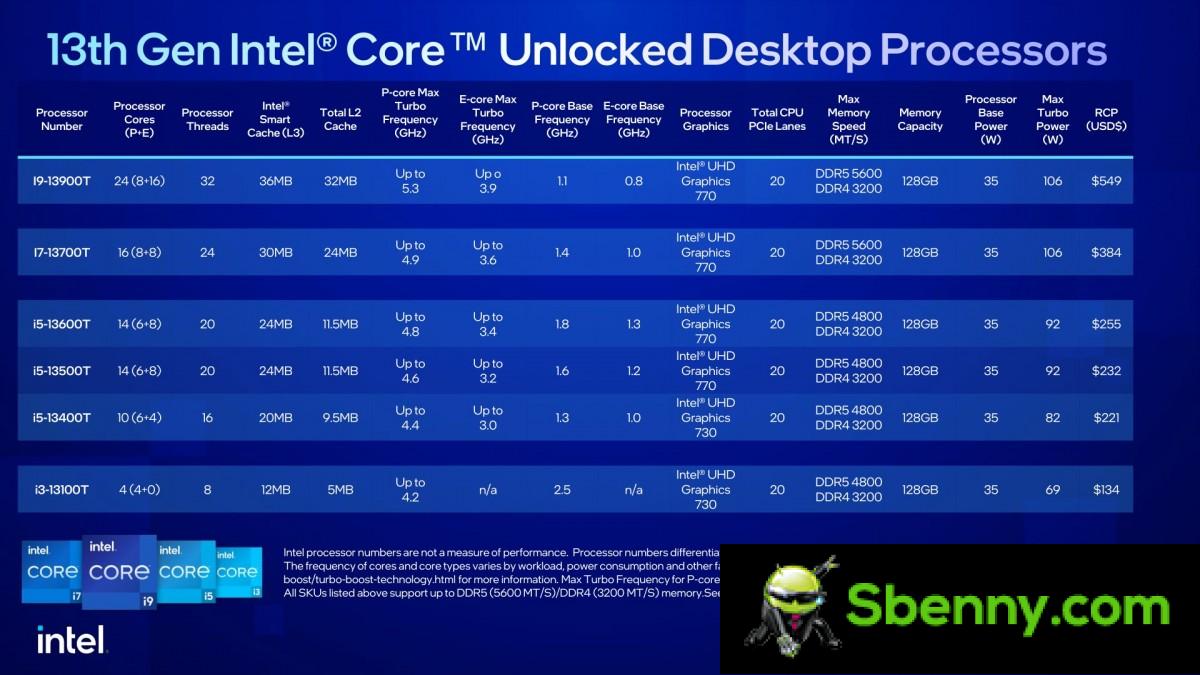
Then there are the T-models, which are heavily downclocked variants designed to achieve lower power draw, 35W at idle and only up to 106W for the range-topping 13900T under turbo. These parts are meant only for OEMs who make pre-built systems and are otherwise not for sale to regular customers.
For pricing, we only have Intel’s RCP amount, which is the unit cost for every 1000 units purchased from the reseller. The actual cost is a little higher, but usually not by much. Overall, there are some interesting numbers, especially the relatively small price gap between the 13500 and 13400 despite the significant difference in specs between the two. The 13100F’s starting price is still great despite the relative lack of improvements over its predecessor, and the 13700F can still be a great all-around CPU for the price.


Start a new Thread