
While we loved the width and height of the original Oppo Find N, we were less satisfied with its thickness and especially its weight: it was bulkier than the larger Galaxy Z Fold4. Oppo has addressed these concerns with the second generation model, while also improving the cover display.
There are many other improvements as well, but before we get into the details we have to mention that Oppo is also introducing its first foldable flip today – don’t miss this one as it’s about to be released internationally.
Oppo Find N2
The Oppo Find N2 is a little narrower than its predecessor at 72.6mm when closed (compared to 73mm). More importantly, the device now weighs just 233g thanks in large part to an improved hinge design. In addition, the thickness is 14.6mm closed and 7.4mm open (compared to 15.9mm and 8.0mm).
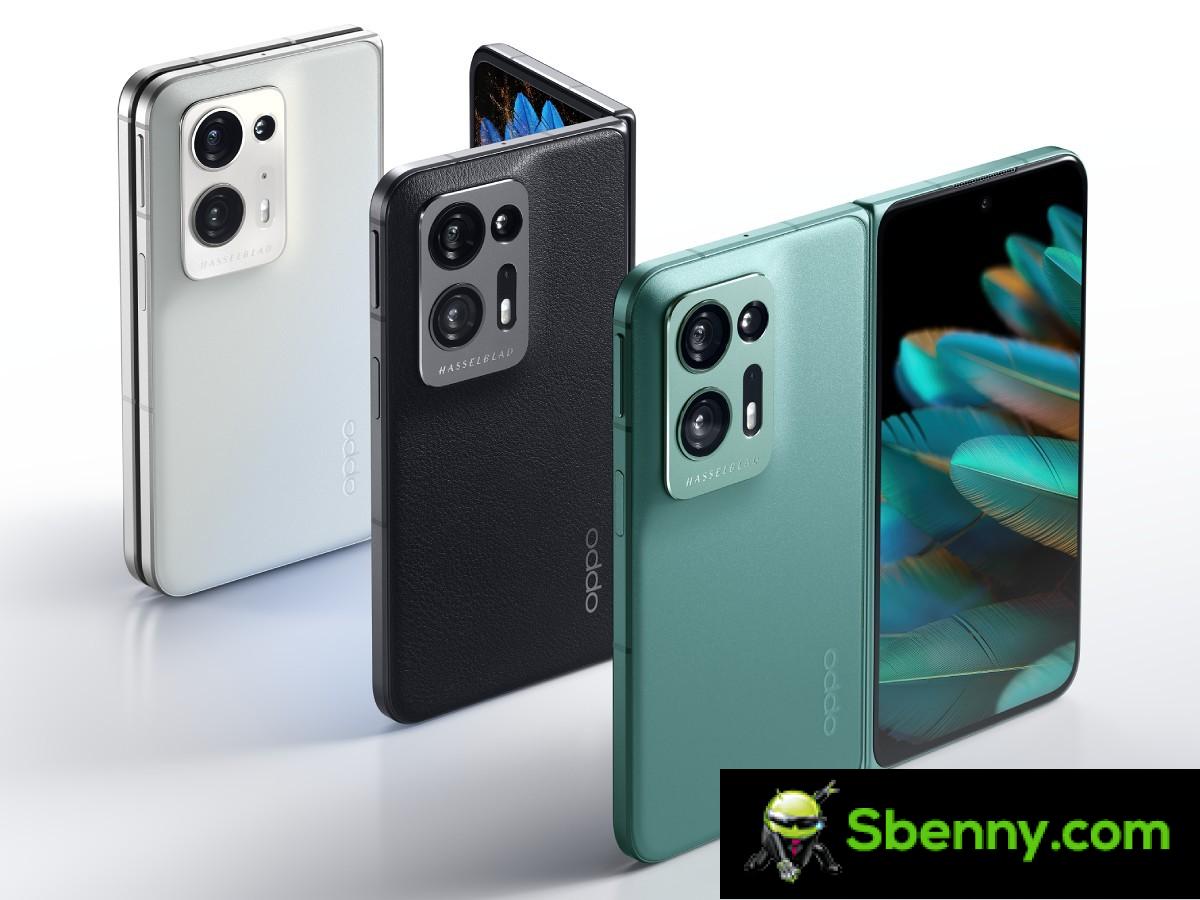
The anodized metal frame comes in three styles: matte white and mint green (these are glass backed and weigh a little more, 237g) and a black option with vegan leather covering the back.
The second generation Flexion hinge has been significantly improved. Firstly, it has fewer parts: 100, compared to 138. Secondly, it uses advanced materials such as carbon fiber and a high-strength alloy. All of this helps reduce the weight of the phone.
The new hinge design also reduces creases by 67%, making them less visible. The hinge can hold any angle between 45° and 125°, which has several use cases, but we’ll get to those.

The cover display has been reworked. It’s still roughly the same size, however, the aspect ratio is slightly down at 17.7:9 (instead of 18:9). Even so, the phone is narrower than its predecessor because Oppo has reduced the bezels. The 5.54-inch cover display now also supports a 120Hz refresh rate. It’s also very bright, peaking at 1,350 nits, and is protected by Gorilla Glass Victus.

The internal display is the same size, 7.1” and a boxy 9.6:9 aspect. This is an LTPO panel, so its refresh rate can vary between 1Hz and 120Hz. Both displays have a touch sampling rate of 480Hz. The display is even brighter than the lid’s, peaking at 1,550 nits.
In addition, Oppo has laminated an anti-reflection film on the display to improve the readability of the screen in bright ambient light conditions even at lower brightness settings. Both displays support HDR10+ and use color sensors to adjust images based on lighting conditions.

Like its predecessor, the Oppo Find N2 offers a triple camera and two selfie cameras. The main module has been upgraded to a Sony IMX890, a 50MP 1/1.56″ sensor, which sits behind a 24mm f/1.8 lens with OIS. This replaces the IMX766 of the same size.
The ultrawide camera got an even bigger upgrade with the 48MP 1/2″ IMX581 sensor, behind a 14mm f/2.2 lens. As a reminder, the original Find N had a 16MP 1/3.09″ sensor.

Then there’s the telephoto lens, which has made the switch to the 32MP (1/2.74”, from 13MP 1/3.4”) IMX709 sensor. In case you don’t recognize the model number, this sensor has an RGBW filter that allows it to gather more light. Even better, it’s paired with a brighter f/2.0 aperture (the Find N had a 13MP f/2.4 camera). The focal length is on the short side, at 47mm it’s shorter than the previous model (52mm). However, perhaps the updates are enough to avoid the problem of the original Find N, which switched to upscaling images from the main camera in the dark.
There are two identical selfie cameras – one on the cover display, one on the inside – both with 32MP sensors.
The camera system is powered by MariSilicon X and was co-developed with Hasselblad. Professional mode uses algorithms to match the Hasselblad Natural Color Solution found on cameras of the same name. Xpan mode is inspired by the panoramic camera of the same name, which used 35mm film but shot wide format and its photos stretched across 65mm. Conveniently, the Xpan mode takes panoramic photos with a wide 65:24 aspect ratio.
The hinge allows for some creative angles: You can shoot from waist level, for example, looking down at your phone, similar to a Hasselblad camera with a waist-level viewfinder. You can even put your phone on the ground and use the hinged design as a tripod of sorts.

Oppo has improved the charging system, which is now rated at 67W and promises to reach 37% in 10 minutes and complete a full charge in 42 minutes (the old system needed 70 minutes to get to 100%). However, wireless charging has been abandoned. Battery capacity is effectively the same at 4,520mAh.
Like its predecessor, the Find N2 is a step down from the current generation of chipsets and uses the Snapdragon 8+ Gen 1. It is paired with 12GB or 16GB of LPDDR5 RAM and 256GB or 512GB of UFS 3.1 storage . The phone comes with Android 13 and ColorOS 13 out of the box.
The Oppo Find N2 will go on sale in China soon, there is no news on a wide release for now. We have a Find N2 in the office by the way, so stay tuned for a full review
Oppo Find N2 Flip
The Oppo Find N2 Flip is the company’s first foldable in this form factor. Its obvious rivals are the Galaxy Z Flip and the Moto RAZR 2022 and this one is distinguished by its quite large 3.2-inch display (a 60Hz OLED panel).
The internal 120Hz AMOLED panel measures 6.8 inches when unfolded. Unlike the Find N2, this one is powered by the Dimension 9000+ chipset.

Oppo Find N2 Flip
The camera setup consists of a 50MP main module and an 8MP ultrawide unit. There is no telephoto lens on board, which is typical for flip phones. There’s a 32MP selfie camera on the internal display, or you can use the main camera thanks to the cover’s large display. MariSilicon X chip is integrated to handle image processing.
This phone has the largest battery of any Flip to date, at 4,400mAh, and at 44W charging it’s also the fastest to top up. For comparison, the Galaxy Z Flip4 has a 3,700mAh battery (25W wired, 15W wireless), the Razr 2022 has 3,500mAh in its tank (30W charging only).
As you have read in the opening paragraphs, the Oppo Find N2 Flip is scheduled for a global release, full details will be made available later.


Start a new Thread