
The Lenovo Legion Y90, released this spring, is a flagship phone that caters directly to gamers. It has the newest and fastest Snapdragon chipset (the 8th Gen 1), a 6.97-inch AMOLED display that refreshes up to 144Hz, two cooling fans, and four gaming triggers. On the audio front, it has two speakers and Dolby Atmos.
We subjected the Lenovo Legion Y90 to our rigorous SBMARK Audio test suite to measure its performance both when recording sound using its built-in microphones, and when playing audio through its speakers.
In this review, we’ll break down how it fared across a variety of tests and several common use cases.
Overview
Key audio specs include:
- Two loudspeakers, one lower and one upper, both in front focus
- No audio jack
- four noise-canceling microphones
- Dolby Atmos
Reproduction
Pros
- The general stamp is good
- Very good punch
- Bass is a strong point
versus
- The breadth is slightly underwhelming; it is quite tight.
- The minimum volume is too low.
Registration
Pros
- Good tonal balance in all use cases.
- Good breadth and localizability in video and live memo.
versus
- Mono video selfie recordings.
The Lenovo Legion Y90 performed very well in our audio tests. Among the devices in this price range (around 600 euros), it achieved one of the best scores ever recorded in our database, with a 76 that ranks it alongside the iPhone 13 Pro Max, which costs hundreds more. Really impressive.
In playback, the Y90 stands out by offering strong bass rendition, a rarity among smartphones. Its tonal balance, albeit good in general, has some flaws which, if corrected in a future edition, could take the score even higher. The Lenovo device performed well in dynamics, with great punch and solid attack. In the spatial attribute, the Y90 did not provide very good amplitude, especially when playing music.
As a recording device, the Y90 captures high quality audio in many different scenarios and exhibits some notable flaws. The tonal balance it produces is good, even when recording in very noisy environments, such as an electronic music concert. Makes voices natural and clear. The device records in mono in selfie videos, which was a notable drawback.
Test summary
Learn about SBMARK audio tests: For scoring and analysis in our smartphone audio reviews, SBMARK engineers perform a series of objective tests and undertake more than 20 hours of perceptual assessment under controlled laboratory conditions.
(For more details on our reproduction protocol, click here; for more details on our registration protocol, click here.)
The following section collects the key elements of our exhaustive tests and analyzes performed in SBMARK laboratories. Detailed performance evaluations in the form of reports are available upon request. Do not hesitate to contact us.
How the audio playback score is composed
SBMARK engineers test playback through smartphone speakers, whose performance is evaluated in our labs and under real-life conditions, using apps and default settings.
Hear about the playback performance of the smartphone tested in this comparison with some of its competitors:
Here’s how the Lenovo Legion Y90 fares in playback use cases compared to its competitors:
Playback of use case scores
The Timbre score represents how well a phone reproduces sound across the audible tonal range and takes into account bass, midrange, treble, tonal balance and volume dependence. It is the most important attribute for reproduction.
The Lenovo Legion Y90 has all the elements to have a rich and well-balanced tone, including surprisingly noticeable bass which is unusual among smartphones. But some key flaws prevent it from reaching its full potential in this attribute. One problem is the lack of high-end extensions. The highs sound slightly muffled and resonant. The midrange is even more resonant, devoid of body and very incoherent. With some audio content, the mid-bass is very exaggerated. While lacking some low-end extension, the basses produced by the Y90 are very present, clear and faithful. Overall, tonal balance is good, largely thanks to that strong low end. Another selling point here is that even at maximum volume, the overall timbre remains true, only harsh highs become more pronounced. For gamers who like their loud sound effects, this is a real plus.
The Dynamics score measures the accuracy of changes in the energy level of sound sources, such as the precision with which a bass note or the impact sound of drums is reproduced.
Overall the Lenovo Legion Y90 performs well in dynamics, with a correct attack and great punch. Bass accuracy is average: sustain is slightly lacking and the upper register of the bass is negatively affected by distortion. The performance here shows that the Y90 is suitable for urban music, where the drums are particularly well rendered.
A lower-end extension would help in this attribute. At nominal volume, attack and overall transients are achieved well. At maximum volume, the bass is heavily compromised by compression and its release is unrealistic and inconsistent. The punch remains good at maximum volume.


Secondary attributes for spatial tests include identifying the position of a specific sound, its positional balance, distance and amplitude.
The Y90 scored slightly better than average in the spatial attribute. Despite a disappointing lack of breadth, localizability is good and it’s easy to pinpoint the exact location of the different elements.


Distance rendering is great, with voices very close to the screen position. The center is well centered. The lack of amplitude is particularly annoying when listening to music, where the amplitude does not even match the physical size of the device, but performs slightly better when used for watching movies.
The volume score represents the overall volume of a smartphone and how the volume gradually increases and decreases based on user input.
The Lenovo Legion Y90 scores well in the volume attribute, despite a minimum volume step which is a bit too low and tends to bury some content. The maximum volume is good.
Here are some sound pressure levels (SPLs) measured while playing our sample recordings of hip-hop and classical music at maximum volume:
| Hip-Hop | Classic | |
| Lenovo Legion Y90 | 76.5 dBA | 69.9 dB |
| Apple iPhone 13 Pro Max | 72.5 dBA | 69.5 dBA |
| Asus ROG Phone 5 | 74.4 dB | 71.2 dBA |
The graph below shows the gradual changes in volume from minimum to maximum. We expect these changes to be consistent across the range, so that all volume levels match user expectations:
The Artifacts score measures the extent to which sound is affected by various types of distortion. The higher the score, the less noise you notice. Distortion can occur due to the sound processing in the device and the quality of the speakers.
The Lenovo Legion Y90 is among the top scorers in our database in this attribute. That said, some low-end elements generate distortion and some hissing noises are observable above the vocal content.
How the score of the audio recording is composed
SBMARK engineers test the recording by evaluating the files recorded on reference audio equipment. These recordings are performed in our labs and in real-life conditions, using apps and predefined settings.
Here’s how the Lenovo Legion Y90 fares in use case registration compared to its competitors:
Record of use case scores
The Timbre score represents how well a phone captures sounds across the audible tonal range and takes into account bass, midrange, treble and tonal balance. It is the most important attribute for registration.
As a recording device, the Lenovo Legend Y90 produces a good tonal balance between use cases. In life videos and selfies, the highs are well rendered, despite a slight lack of high-end extension that would have provided brightness and accuracy. The midrange is more focused on the high mids and could benefit from more mid-low warmth, but overall it’s not unpleasant. In general, the voices sound natural. In the case of using a high sound pressure level (an electronic music concert), the tonal balance remains satisfactory, although a deeper low end (sub) would have made it even better.
The Dynamics score measures the accuracy of changes in the energy level of sound sources, such as how accurately the explosives of a voice (p, tek, for example) are reproduced. The score also considers the signal-to-noise ratio (SNR), such as how loud the main voice is compared to the background noise.
The Y90 performs well in recording dynamics, capturing a high-pitched envelope that allows for perfect understanding of vocals and high-pitched explosives. In life videos and selfie videos, the signal-to-noise ratio (SNR) is correct, but the background could be more subdued. In the case of use with high SPL, the return of transients is good.


Secondary attributes for spatial tests include identifying the position of a specific sound, its positional balance, distance and amplitude on recorded audio files.
The Lenovo device is in medium territory in the spatial attribute. The breadth and localizability are good when using the life video and memo apps. The selfie video, however, records in mono, compromising localizability. Distance restitution is realistic thanks to consistent averages.

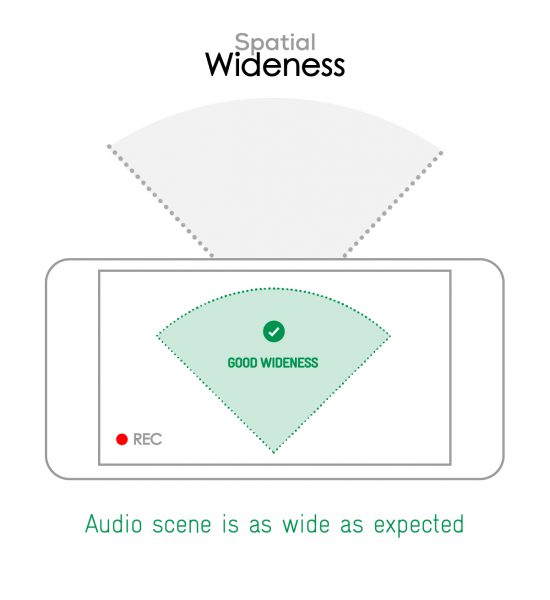
The volume score represents the normalization level of the audio on the recorded files and how the device handles noisy environments, such as electronic concerts, during recording.
The recording volume was good in all use cases.
Here are the sound levels recorded in the audio and video files, measured in LUFS (Loudness Unit Full Scale); as a reference, we expect loudness levels to be higher than -24 LUFS for recorded content:
| Match | Life video | Selfie video | Memo | |
| Lenovo Legion Y90 | -28.1 LUFS | -19 LUFS | -18 LUFS | -22.9 LUFS |
| Apple iPhone 13 Pro Max | -25.5 LUFS | -22.7 LUFS | -20.2 LUFS | -18.2 LUFS |
| Asus ROG Phone 5 | -22 LUFS | -21.2 LUFS | -17.9 LUFS | -18.5 LUFS |
The Artifacts Score measures the extent to which recorded sounds are affected by various types of distortions. The higher the score, the less noise you notice. Distortions can occur due to the sound processing in the device and the quality of the microphones, as well as user handling, such as the way the phone is held.
Recordings produced by the Lenovo Legion Y90 show few artifacts overall. In the life video and selfie, there is a slight distortion in the screaming voices. Slight compression is noted when recording in high SPL scenarios, but it is not intrusive.
Hear about the artifacts in this excerpt, which was recorded in a fast-paced home environment:
Background evaluates how naturally the various sounds around a voice blend into the video recording file. For example, when recording a speech at an event, the background should not interfere with the main voice, but should provide context for the surrounding environment.
The wallpaper produced by the Lenovo device has a good tonal balance. There is a natural restitution of the background, despite a slight lack of treble.



Start a new Thread