
We subjected the Samsung Galaxy Z Flip4 to our rigorous SBMARK Audio test suite to measure its performance both when recording sound using its built-in microphones, and when playing audio through its speakers.
In this review, we’ll break down how it fared across a variety of tests and several common use cases.
Overview
Key audio specs include:
- Two speakers (top center front, bottom right)
- No audio output Jack
- Dolby Atmos technology
Reproduction
Pros
- Good tonal balance
- Good dynamics
- Almost free of artifacts
versus
- Considering the size of the device, the spatial performance is slightly underwhelming
- Volume performance not on par with other Galaxy series devices
Registration
Pros
- Good stamp in all recordings except in the case of use of the concert
- Excellent signal-to-noise ratio
- Excellent distance yield
versus
- Too much information around 200Hz makes some recordings confusing and unclear
- Incredible wind noise reduction
- No audio zoom function
With a SBMARK Audio score of 130, the Samsung Galaxy Z Flip4 delivers overall reliable and consistent audio performance, both in playback and recording, and achieves similar results to many other Samsung Galaxy models. However, it fails to keep up with the best in class.
In Playback, it performs at a very similar level across all use cases, delivering good tonal and dynamic balance, with almost no artifacts. However, our testers expected better space performance, as the device is quite large when open and, in terms of volume, the Z Flip4 isn’t quite on par with some of its more conventional Samsung Galaxy cousins.
As a recording device, the Z Flip4 works best for front camera and main camera recordings and is less recommended for office and clipboard recordings, mainly because it defaults to mono recording when using the corresponding apps. On top of that, recordings made with the Samsung offer good timbre in most use cases, as well as excellent signal-to-noise ratio and distance rendering. Among the disadvantages, wind noise reduction is not very effective and the device does not have an audio zoom function.
Test summary
Learn about SBMARK audio tests: For scoring and analysis in our smartphone audio reviews, SBMARK engineers perform a series of objective tests and undertake more than 20 hours of perceptual assessment under controlled laboratory conditions.
(For more details on our reproduction protocol, click here; for more details on our registration protocol, click here.)
The following section collects the key elements of our exhaustive tests and analyzes performed in SBMARK laboratories. Detailed performance evaluations in the form of reports are available upon request. Do not hesitate to contact us.
How the audio playback score is composed
SBMARK engineers test playback through smartphone speakers, whose performance is evaluated in our labs and under real-life conditions, using apps and default settings.
In Playback, the Z Flip4 offers a pleasant tone, with a sound similar to other Galaxy phones, such as the A52 or the S22 Ultra. However, the midrange is less consistent, which results in a slightly more subtle tonal balance overall. The Samsung Z Flip4 device also performs well in dynamics, with a crisp and precise attack, good bass accuracy and decent punch, despite the lack of support for low-mid frequencies.
The Flip4’s stereo speakers offer a good breadth of the stereo scene, but considering the phone’s fairly large size when unfolded, we expected even better. Distance rendering is overall correct and depth perception is decent for common types of content. However, localizability could be better, with individual instruments sometimes sounding fuzzy within the soundstage. Maximum volume is decent and on a similar level to the more conventional Galaxy S22 Ultra. The minimum volume, on the other hand, is a little too low, which means that some content, such as classical music, can be difficult to consume at this volume setting. As with all of Samsung’s Galaxy series devices, audio artifacts are very well controlled, with only slight distortion and compression at maximum volume. The device is also designed to reduce the risk of accidentally covering the speakers with your hands.
Hear about the playback performance of the smartphone tested in this comparison with some of its competitors:
Samsung Galaxy S22 Ultra (Exynos)
Recordings of smartphones that play some of our music at 60 LAeq in an anechoic environment from 2 microphones in AB configuration, at 30 cm
Here’s how the Samsung Galaxy Z Flip4 fares in playback use cases compared to its competitors:
Playback of use case scores
The Timbre score represents how well a phone reproduces sound across the audible tonal range and takes into account bass, midrange, treble, tonal balance and volume dependence. It is the most important attribute for reproduction.
Music playback frequency response
A 1/12 octave frequency response graph, which measures the volume of each frequency emitted by the smartphone when playing a pure sine wave in an anechoic environment.
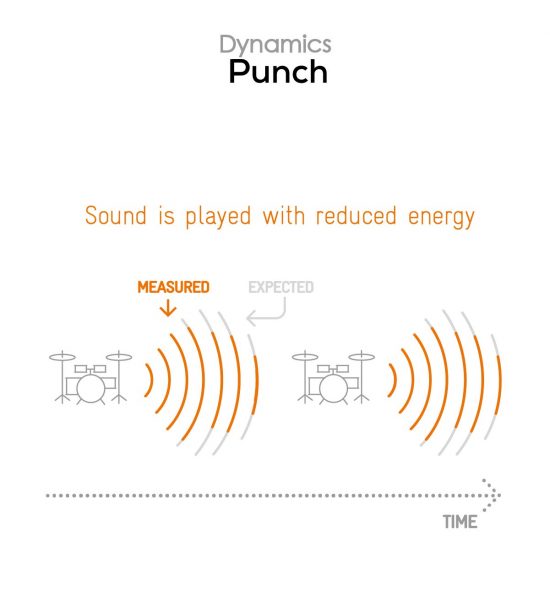
The Dynamics score measures the accuracy of changes in the energy level of sound sources, such as the precision with which a bass note or the impact sound of drums is played.

Secondary attributes for spatial tests include identifying the position of a specific sound, its positional balance, distance and amplitude.


The volume score represents the overall volume of a smartphone and how the volume gradually increases and decreases based on user input.
Here are some sound pressure levels (SPLs) measured when playing our sample recordings of hip-hop and classical music at maximum volume:
| Hip-Hop | Classic | |
| Samsung Galaxy Z Flip4 | 73.6 dB | 68.4 dB |
| Apple iPhone 14 | 74.8 dBA | 71.9 dBA |
| Samsung Galaxy S22 Ultra (Exynos) | 74.1 dB | 70.2 dBA |
The graph below shows the gradual changes in volume from minimum to maximum. We expect these changes to be consistent across the range, so that all volume levels match user expectations:
Music volume texture
This line graph shows the relative playback volume versus the user-selected volume step, measured at different volume levels with correlated pink noise in an anechoic box recorded on axis at 0.20 meters.
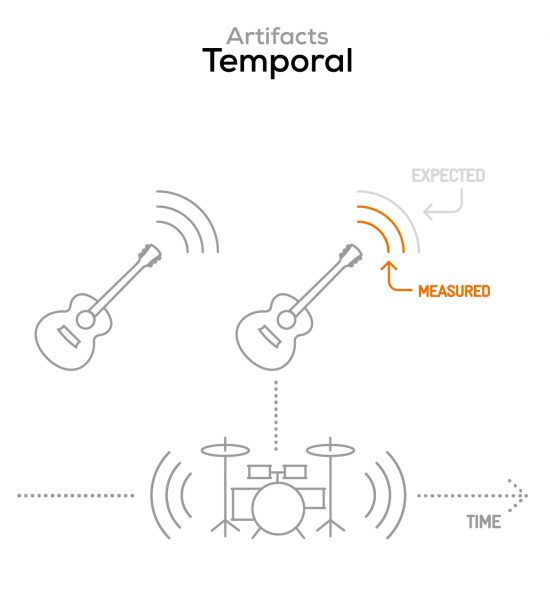
The Artifacts score measures the extent to which sound is affected by various types of distortion. The higher the score, the less noise you notice. Distortion can occur due to the sound processing in the device and the quality of the speakers.

Total harmonic distortion reproduction (maximum volume)
This graph shows the total harmonic distortion and noise in the audible frequency range.
It represents the distortion and noise of the device reproducing our test signal (0 dB Fs, Sweep Sine in an anechoic box at 40 cm) at the maximum volume of the device.
How the score of the audio recording is composed
SBMARK engineers test the recording by evaluating recorded files on reference audio equipment. These recordings are performed in our labs and in real-life conditions, using apps and predefined settings.
Overall, the Z Flip4 is better for sound recording than for playback. The recording tone is good, with an overall satisfactory low-mid range and a pleasant bass rendition. However, a less present mid-high range contributes to a less clear sonority and a slightly recessed treble extension, making the treble sound a bit dull.
Dynamic performance is good, with excellent signal-to-noise ratios when recording with the selfie camera and decent values for all other use cases. The envelope rendering is also correct in all use cases, but it lacks some precision. The attack is decent but could be more precise. The Samsung performs well for spatial attributes when recording, with excellent distance rendition and good stereo width when recording with the main camera. However, the amplitude is reduced when recording in portrait orientation with the front camera and the recorder app is mono by default.
The recording volume is mostly correct, but in real life scenarios the volume can drop considerably if there is a lot of background noise. This is especially true for front camera recordings and when using the recorder app. The Z Flip4 performed exceptionally well for maximum volume and is capable of handling loud recordings with only a little distortion.
However, the usual moderate distortion and compression are evident in recordings of high volume content, and the Z Flip4 seems quite sensitive to microphone occlusions and finger noises, resulting in fluctuating cuts, filters and modulations. Background rendering is very good, with excellent tonal balance, well-controlled artifacts and only some volume fluctuations.
Here’s how the Samsung Galaxy Z Flip4 fares in recording use cases compared to its competitors:
Record of use case scores
The Timbre score represents how well a phone captures sounds across the audible tonal range and takes into account bass, midrange, treble and tonal balance. It is the most important attribute for registration.
Life video frequency response
A 1 / 12th octave frequency response graph, which measures the volume of each frequency captured by the smartphone when recording a pure sine wave in an anechoic environment.
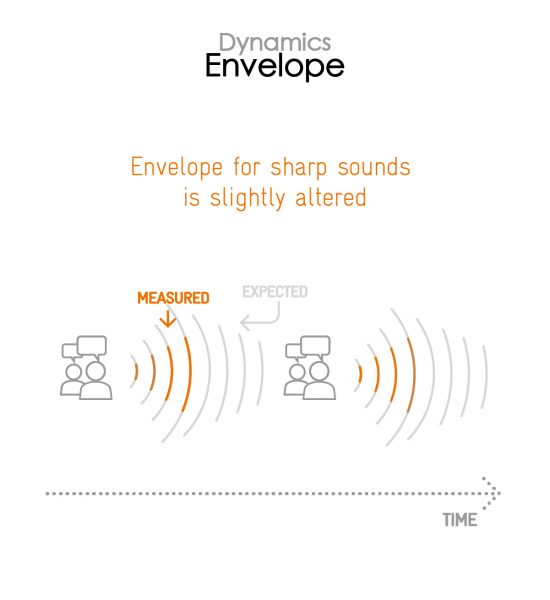
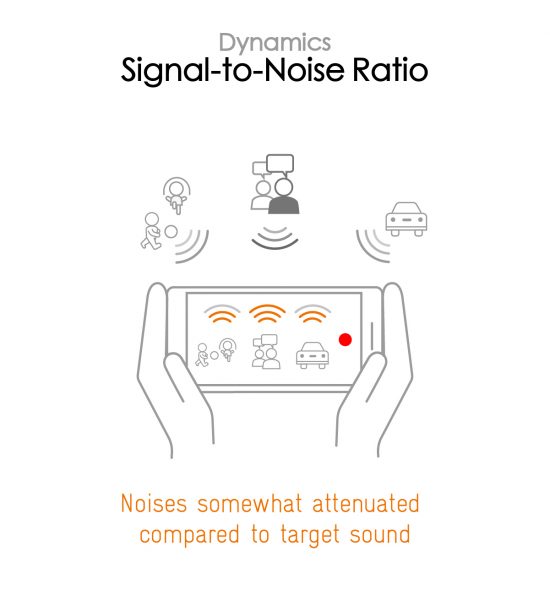
The Dynamics score measures the accuracy of changes in the energy level of sound sources, such as how accurately the explosives of a voice (p, tek, for example) are reproduced. The score also considers the signal-to-noise ratio (SNR), such as how loud the main voice is compared to the background noise.
Secondary attributes for spatial tests include locating the position of a specific sound, its positional balance, distance and amplitude on recorded audio files.


Directivity of registration
Smartphone directivity graph when recording test signals using the camera app, with the main camera. It represents the acoustic energy (in dB) on the angle of incidence of the sound source. (Normalized to the 0 ° angle, in front of the device.)
The volume score represents the normalization level of the audio on the recorded files and how the device handles noisy environments, such as electronic concerts, during recording.
Here are the sound levels recorded in the audio and video files, measured in LUFS (Loudness Unit Full Scale); as a reference, we expect loudness levels to be higher than -24 LUFS for recorded content:
| Match | Life video | Selfie video | Memo | |
| Samsung Galaxy Z Flip4 | -25.2 LUFS | -21.5 LUFS | -19.7 LUFS | -21.6 LUFS |
| Apple iPhone 14 | -23.8 LUFS | -22.5 LUFS | -20.5 LUFS | -18.7 LUFS |
| Samsung Galaxy S22 Ultra (Exynos) | -28.8 LUFS | -21.7 LUFS | -21.2 LUFS | -23.9 LUFS |
The Artifacts Score measures the extent to which recorded sounds are affected by various types of distortions. The higher the score, the less noise you notice. Distortions can occur due to the sound processing in the device and the quality of the microphones, as well as user handling, such as the way the phone is held.


In this audio comparison, you can hear how this smartphone handles wind noise compared to its competitors:
Recordings of a voice sample with light background noise, facing a turbulent wind of 5 m / s
Background evaluates how naturally the various sounds around a voice blend into the video recording file. For example, when recording a speech at an event, the background should not interfere with the main voice, but should provide context for the surrounding environment.



Start a new Thread