
There rose scab it is one of the main diseases that affects this flowering plant. It can indiscriminately attack both intensive crops and more or less isolated plants in a garden or in a public park. There are varieties of roses more or less susceptible to this plant disease, but in general none is free from it.
Scab mainly affects the leaves of roses, with typical and quite recognizable symptoms. To prevent this fungus from ruining our flowers, we can act first of all with adequate agronomic techniques and then with organic products.
In this article, therefore, we see everything there is to know about rose scab and its cure.
What is rose scab
Rose scab is caused by the fungal agent Diplocarpon rosae (sexual form) or Marssonia rosae (asexual form), forming part of the division Eumycotasub-division Ascomycotine.
The fungus overwinters inside fallen leaves or in micro-lesions on the stems, thanks to structures called pycnidia, which develop spores inside them.
In spring, the mild temperatures associated with rainy periods awaken the fungus, which begins to produce conidia or ascospores. These are carried on the vegetation by rain and wind, starting to form the characteristic spots and the production of acervuli, or microscopic fungal hyphae, which in turn produce other spores. These can give rise to secondary infections, moving (thanks to the wind) to nearby rose plants.
Environmental conditions favorable to scab
As mentioned, the scab of roses is favored by rainy and humid periods, with stagnation of humidity on the leaves, and relatively high temperatures, around 20-25 °C. These conditions usually occur in spring or late summer.
How to recognize rose scab
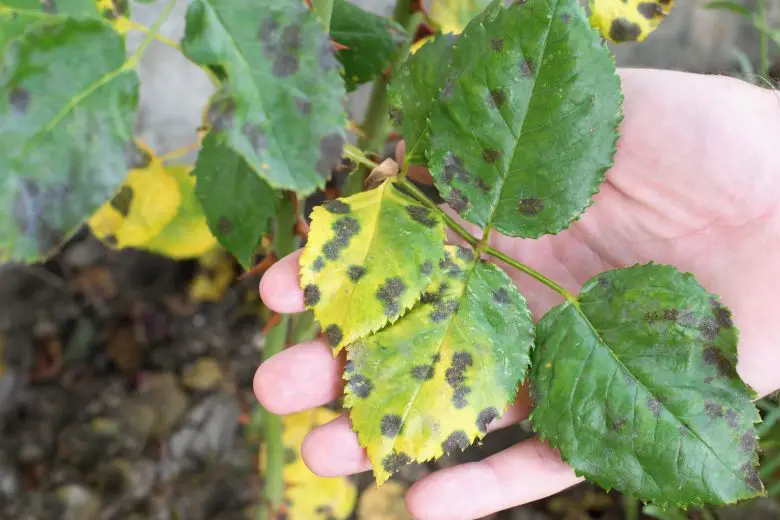
The main symptom that distinguishes scab from others diseases of roses, manifests itself on the leaves, in particular on the upper page, and consists of the appearance of roundish blackish spots. These spots have irregular, “flame” edges that extend onto the lamina. They can also have variable dimensions, with a diameter ranging from a few millimeters to a few centimetres. If the scab progresses, the spots tend to converge, causing the blackening of a large part of the leaf surface. The edges of the spots, or the margins of the heavily affected leaves, can take on intense chlorotic shades.
Scab can also attack the stems, especially the younger ones, with the formation of lesions that appear as irregular necrotic spots.
Damage to rose plants
The final result of rose scab is a more or less intense defoliation. In the case of particularly sensitive varieties, the fall of the leaves (phylloptosis) can be total, due to the necrosis of the leaf tissues. Rose plants affected by scab are subject to strong weakening, caused by continuous and forced re-sprouting. Obviously flowering is inevitably compromised.
Which roses are most susceptible to scab?
Different varieties of rose show different sensitivity to scab. Miniature roses are by far the most sensitive, however common bush or sapling roses can also be affected. More resistant are some botanical roses derived from crossings with the Wrinkled rosethe Rose polyantha and the Wichura rose. We are working on these to obtain resistant hybrids.
How to prevent scab on roses
Now let’s see what are the agronomic prevention techniques to be implemented to prevent rose scab. First you need to choose the right exposure for our plants in the garden. The best exposure is the sunny one, with a good air exchange. Closed and shady corners of the garden are to be avoided, conditions that favor humidity and therefore scab. During the growing season, rain irrigation of the plants should be avoided, the best thing is a moderate wetting at ground level.
The fertilization of the plants must be as balanced as possible, avoiding excess nitrogen.
On the affected plants it is necessary to intervene by removing the infected leaves at the first symptoms, so as not to advance the disease to the healthy vegetation. In case of serious attacks, all the leaves that have fallen to the ground must be eliminated, in order to avoid scab infections in the following seasons.
In both cases, the leaves must be removed from the plant, preferably burned.
Remedies for rose scab
Treating roses affected by scab is not easy at all, especially when the disease has affected the plants extensively. There are actually very few organic products that can be used to remedy a scab infestation, and they are all preventive rather than curative.
The most used product in the prevention of rose scab is copper, in its different formulations available. It is a remedy that should be used for a maximum of 1-2 treatments, done at the beginning of the spring season, when the chances of the disease occurring are highest (before a heavy rainy period, for example, even if the water then easily washes away the product).
Other natural remedies
Alternative products to copper are the sodium bicarbonate and the micronized zeolitewhich we have told you extensively about.
Copper, bicarbonate and zeolite can be used alternately, so as not to always insist on the same active ingredient, thus avoiding causing phytotoxicity phenomena.
Finally, we point out the Bacillus subtilis, a bacterium naturally present in the soil and used in the microbiological fight against fungal diseases of plants. However, commercial products with this bacterium are still difficult to find.




Start a new Thread