
The phenomenon of Odin: Valhalla Rising has finally reached the global market and, as usually happens with the great MMORPGs that come from South Korea, it has unleashed a good handful of conflicting opinions. On the one hand, its visual proposal and its Nordic setting have left many players with their mouths open; On the other hand, its strong automatic play component and a fairly aggressive monetization system have set off all the alarms among those looking for more traditional experiences that are less dependent on gacha.
Even so, talk about Odin: Valhalla Rising Just as “another mess” would be oversimplifying a huge project, with an open world without loading screens (except in instanced dungeons), a firm commitment to cross-play between PC and mobile and a constant pace of updates. We are going to break down what is a new generation MMORPG, what is behind its auto-play system, why it has taken South Korea by storm and what you can find if you decide to give it a try.
A new generation MMORPG with a Korean soul
Odin: Valhalla Rising is presented as an open world MMORPG developed with Unreal Engine 4, with a brutal emphasis on the visual and the scale of the setting. The game takes you to a universe inspired by Norse mythology, with kingdoms and creatures typical of these legends: giants, dwarves, elves and all that imagery that we usually associate with Scandinavian myths, but passed through the spectacular filter of a modern MMO.
The design of the world is committed to a continuous map without loading screens outside of the instanced dungeons, something that greatly helps the feeling of being in a cohesive environment. You travel through large areas connected to each other, see other players moving, fighting monsters or exploring just like you, and all this on both PC and mobile devices thanks to the official cross-play that Kakao Games has promoted from the beginning.
The intention is for you to live a Large-scale MMORPG that is not limited to a single type of content: there is PvE, there is PvP, there are massive battles, there are dungeons and a constant progression of equipment, skills and classes. In this sense, Odin tries to position itself as one of those “all-in-one” titles that seek to become your main game for a long time.
Norse mythology and a big visual epic
One of the biggest claims of Odin: Valhalla Rising is its nordic setting. The game recreates kingdoms inspired by the myths of gods and legendary creatures: you will travel through settings that draw on worlds such as Midgard, Jotunheim and other domains typical of Scandinavian mythology, always with a very marked layer of heroic fantasy.
Players meet mythical races such as giants, dwarves and elveswhich are not only part of the lore, but also of the bestiary and the great bosses that you will face in raids and dungeons. The enemies have been designed to impress: they are huge, with spectacular animations, striking attack patterns and a staging that tries to make every important fight seem like a battle of gods and legendary beasts.
Thanks to Unreal Engine 4the game looks well above the average of traditional mobile MMORPGs. The animations, skill effects, lighting and the size of the settings give the feeling of being in front of a high-budget product. Many YouTubers and content creators have highlighted precisely that: the graphics look really impressive, especially considering that the title also works on mobile.
Classes, playstyle and daily life in Valhalla
In terms of gameplay, Odin: Valhalla Rising is committed to four base classes well differentiated in their global version: Warrior, Sorceress, Priest and Rogue. Each has their own classic MMO role: the Warrior serves as a tough melee combatant, the Sorceress provides ranged magic damage, the Priest focuses on healing and support, and the Rogue excels with his explosive damage and mobility.
On that basis, the game introduces subclasses and new specializations. A key example is the arrival of The Bard, a new Priest subclass that has been added as part of the big updates. This variant transforms the traditional support character into a combatant capable of dominating the battlefield with music, using his harp to empower allies and annoy enemies with abilities that alter their performance.
The game encourages you to adapt your style to the content you are facing: you can focus more on massive PvE, raids or PvP, always looking for the build and specialization that best fits your way of playing. The idea is that although the game has automatic mechanics, there is some room to customize the experience through classes, equipment and skills.
The big issue: an almost completely self-play MMORPG
Here we come to the most controversial point of Odin: Valhalla Rising. Since the first days after its global launch, many players have pointed out that the game is practically “full auto”. This means that many of the actions that in a traditional MMO you would execute manually (moving, attacking, chaining skills, farming enemies) can be delegated to the auto-play system.
In practice, the character can fight, scroll, and even complete much of the content automatically. For practical purposes, the player becomes more of a manager than an executor: you set priorities, choose skills, prepare the equipment and let the character do the repetitive work for you, something very common in the Korean mobile market, where playing time is combined with an almost “idle game” approach.
A detail that has bothered many users is the absence of a dodge key. Bosses have spectacular attacks and visually impressive patterns, but the system doesn’t allow you to react with a classic evasion move like the dodge roll or a dedicated ability. That makes combat feel less technical than its appearance might suggest, bringing it closer to a more “on rails” experience, where you accept damage or mitigate it with stats and healing instead of relying so much on your manual skill.
This combination of almost total auto-play and absence of fine reactive actions leads many players to wonder if this is really the “future” of MMORPGs in South Korea: graphically spectacular games, gigantic in scale, but designed to be played largely alone, while the player monitors progress, manages resources and focuses on the most key content, such as large raids or organized PvP.
Monetization, gacha and controversy with cosmetics
Another of the points that has generated the most debate around Odin: Valhalla Rising is its gacha type monetization system. Although the game is presented as free-to-play, a good part of its income goes through boxes and summoning systems that are very reminiscent of other Korean titles such as Lineage 2M or Trickster M.
The most controversial aspect is that these porridge not only offers cosmetics purely aesthetic, but some of those visual objects come with not inconsiderable stat bonuses. For example, there are cosmetics that grant up to a 100% increase in attack speed, in addition to other improvements to the character’s statistics. This creates a clear pay-to-win or, at the very least, pay-for-advantage situation, something that many Western players view with considerable suspicion.
There are many who have described the game as another “room grabber”that is, a very attractive MMO that, as soon as you delve deeper, depends disproportionately on chance systems designed for those who are willing to spend large sums of money in search of the perfect configuration. This approach is not new within the Korean market, but it clashes quite a bit with the idea of classic MMORPG, where power differences should come mainly from dedication and skill within the game.
Success in Korea, global landing and 20 million downloads
Despite all the criticism, the numbers for Odin: Valhalla Rising are overwhelming. The game debuted in South Korea in 2021 and, since then, he has been building a very broad player base in his home region. With the global launch, Kakao Games has managed to exceed 20 million downloads in just one month, an impressive figure that confirms the interest of the international community in this type of MMORPG.
The title has been released in multiple languagesincluding Spanish, English, Thai, Simplified Chinese, Traditional Chinese and Japanese. This not only opens the door to players from different regions, but also encourages the creation of local communities in each language, which translates into more guides, more content on YouTube, and more discussion on social networks.
Additionally, the game is available free on both PC and mobile deviceswith official cross-play support. This means that you can progress with your account from your mobile when you are away from home and continue on the PC more comfortably when you sit down to play seriously, something very attractive for those who do not want to limit themselves to a single platform.
Constant updates and the first big anniversary
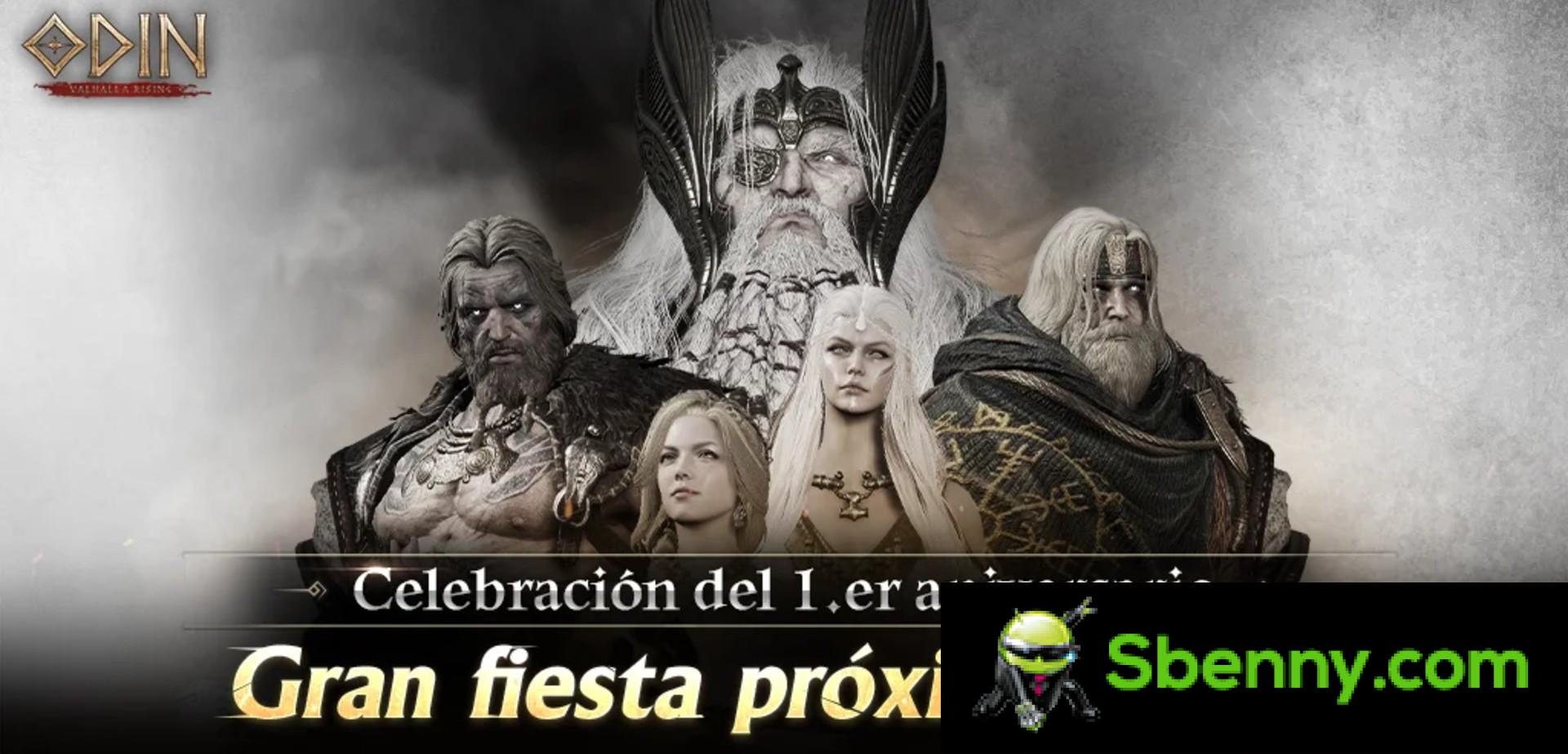
One of Kakao Games’ key strategies to keep Odin: Valhalla Rising alive has been a constant pace of updates and events. The first global anniversary event, called “1st Anniversary Event: Grand Festa of Valhalla”, stands out especially, which is presented as a festival to celebrate the first year of the game’s life internationally.
This event is promoted as the great festival of Valhallawith very juicy rewards for players who connect during the celebration period. The theme revolves around the idea that the gods offer “the greatest possible rewards”, making this anniversary a perfect excuse to return to the game or to accelerate the progress of characters that are already active.
Along with the anniversary, the official roadmap advances more summer-themed dungeons and cosmeticswhich fits with the usual strategy of Korean MMORPGs: constant content aligned with seasons, holidays and themed events to keep the player’s attention and offer new goals in the short and medium term.
New classes and evolution of the metagame
The release of the subclass The Bard for the Priest It’s a good example of how the game tries to refresh the metagame from time to time. This new role uses music as a combat tool, supporting allies with buffs and heals, and annoying enemies with debuffs and effects that can turn the tide of a fight.
In a title where the auto-play has so much weightthe arrival of new classes and subclasses also serves to give a certain fresh air to the experience, encouraging players to try other styles, to raise new characters or to rethink their role within the guilds. In this way, the game does not remain stuck in the initial configuration of classes, but rather expands the offer and allows greater diversity of compositions in groups and raids.
Guild dungeons, raids and cooperative raids
One of the pillars of the first major global update has been the cooperative content for guilds. Kakao Games has introduced a Guild Dungeon system, Guild Raids and a Raid system that seeks to enhance interaction between members of the same community.
The Guild Dungeons They are designed as boss instances with up to 10 levels of difficulty. As the guild group completes each level, the rewards improve, encouraging players to organize and progress as a team. These dungeons are only available to guilds that have reached at least level 4, which adds an extra layer of collective progression.
By defeating guild bosses in these dungeons or in specific raids, players gain objects that are auctioned exclusively within the guild itself. Profits from these auctions are shared among members, encouraging cooperation and reducing direct conflict over loot, while maintaining a clear economic incentive for all participants.
Additionally, it has implemented a Raid Party system which allows guild members to form large groups to tackle dungeons and high-level encounters together. This system is complemented by an improved alliance chat, designed to coordinate PvP events and large scale raids, where multiple guilds can collaborate or face each other.
Massive battles, PvP and the road to Valhalla
The DNA of Odin: Valhalla Rising includes a strong component of large scale battles. Beyond the purely PvE content, the game offers different competitive modes where players face each other or organize themselves into large forces to assault common objectives.
These struggles are usually framed in the idea of conquer the right to Valhallafacing gods, legendary beasts and other players for control of strategic locations or for special rewards. The design of these modes is intended to take advantage of the scale of the game: dozens or even hundreds of characters on screen, unleashed abilities, and a sense of organized chaos reminiscent of other great Korean MMOs.
The less attractive side of these battles is that, due to the weight of stats and equipment obtained many times via gachacompetitive balance may be compromised. Players who invest more money tend to have an advantage, something that is quite noticeable in a massive PvP environment and can frustrate those who prefer a more equal experience.
Events, login rewards, and friendlier progression
To soften that feeling of spending dependence a little, the game offers Frequent events with login rewards. On the occasion of the great cooperative update, for example, a login event has been enabled that gives away a Divine Avatar Summon Ticket x11, in addition to other very valuable items to accelerate the characters’ progress.
These campaigns allow new players get up to speed faster and they give veterans an extra push to continue improving their team. It’s a very typical formula in free-to-play: the game encourages you to return day after day with gifts that increase in value the more constant you are, and that make progressing without paying more viable, although never as fast as if you dedicate real money to the gacha.
Official community and presence on networks
Kakao Games has opted for a very active presence in communities and social networks for Odin: Valhalla Rising. The game has an official website, Discord server, Facebook page and YouTube channel where trailers, update previews, patch notes and events are shared.
This network of official channels serves to centralize communication with playersresolve frequently asked questions, channel feedback and promote new content. In addition, thanks to the Discord server and social networks, it is easy to create guilds and groups in different languages, something key in a global MMORPG where coordination and team play are so important.
With all of the above on the table, Odin: Valhalla Rising establishes itself as a New generation MMORPG that mixes an impressive visual presentation, a very powerful Nordic setting and a huge emphasis on auto-play and the gacha model.
Those who enjoy more passive experiences, packed with large-scale cooperative content and constant events, will find a massive world to engage with here; Those looking for a more technical MMO, with deep manual control, less dependence on chance and a less pay-to-win system, will have to calmly assess whether the trip to Valhalla is worth the toll that its Korean model implies. Share this information so that more people know about the topic.


Start a new Thread