
Oppo believes that producing high quality products is the best way to retain consumers and has implemented strict quality controls throughout the organization. At the heart of these is the Oppo QE Reliability Lab, founded in 2017 at the Greater Noida plant in India.
Seemingly simple decisions actually require a lot of research, planning and development. For example, the Oppo F21 Pro was launched a couple of weeks ago with a “Sunset Orange” leatherette back. But that’s the end of the story.

Oppo’s QE reliability laboratory
The story begins with several thousand different textures that Oppo’s designers went through. Six were screened and sent for market research. Of these, a litchi grain leather texture was chosen. In reality, putting it on a phone required the creation of a “fiberglass skin”, which could be used as a back panel without requiring internal supports. The manufacturing process also took a lot of work to understand.
The fiberglass-leather material is tested for durability by wiping it with an alcohol swab, an eraser and a piece of denim 5,000, 10,000 and 200,000 times respectively.

Can your jeans rub through the outside of the phone?
Each new model created by Oppo must undergo a series of tests that simulate years of daily wear and various accidents. The lab is looking into how much damage a phone can take before it breaks, but also what causes cosmetic problems.
The simple drop test is made tougher than the industry average, allowing phones to go from a height of 1m instead of 0.8m. Phones fall on all 6 sides, 8 corners and 12 edges 12 to 24 times. And to top it off, the phone dropped 1.5m in three extreme tests.
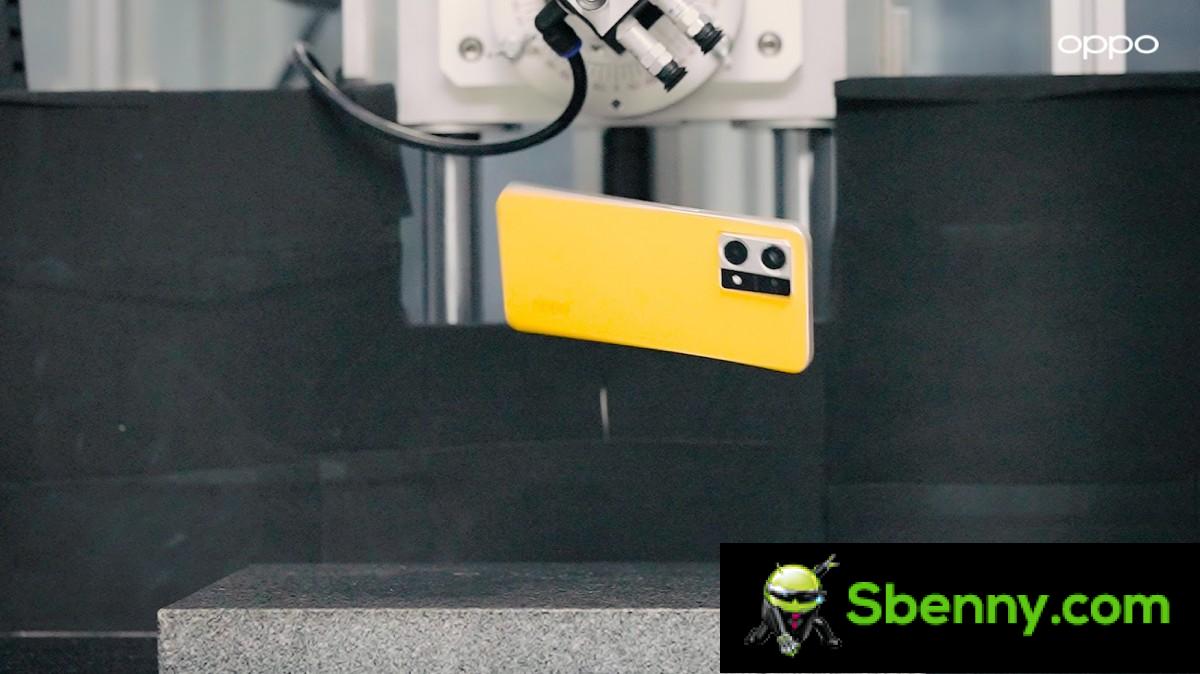
An Oppo F21 Pro in the middle of a drop test
Height isn’t the only problem, small drops on an abrasive surface can ruin a shiny new phone. Oppo uses sandpaper, and phones don’t get the benefit of a screen protector or case.
At OPPO, our products undergo rigorous testing processes to offer the best quality in all aspects and the stunning # OPPOF21ProSerie has successfully completed everything, giving you a #OPPO Quality promise.
Buy now: https://t.co/pCd5DDpcte pic.twitter.com/6nhXZRhVGP– OPPO India (@OPPOIndia) April 29, 2022
Then, even more drops: the phone is placed in a 1 meter long case that spins at 3.5 revolutions per minute. At the end of 15 revolutions, she suffered the equivalent of 150 1m falls.
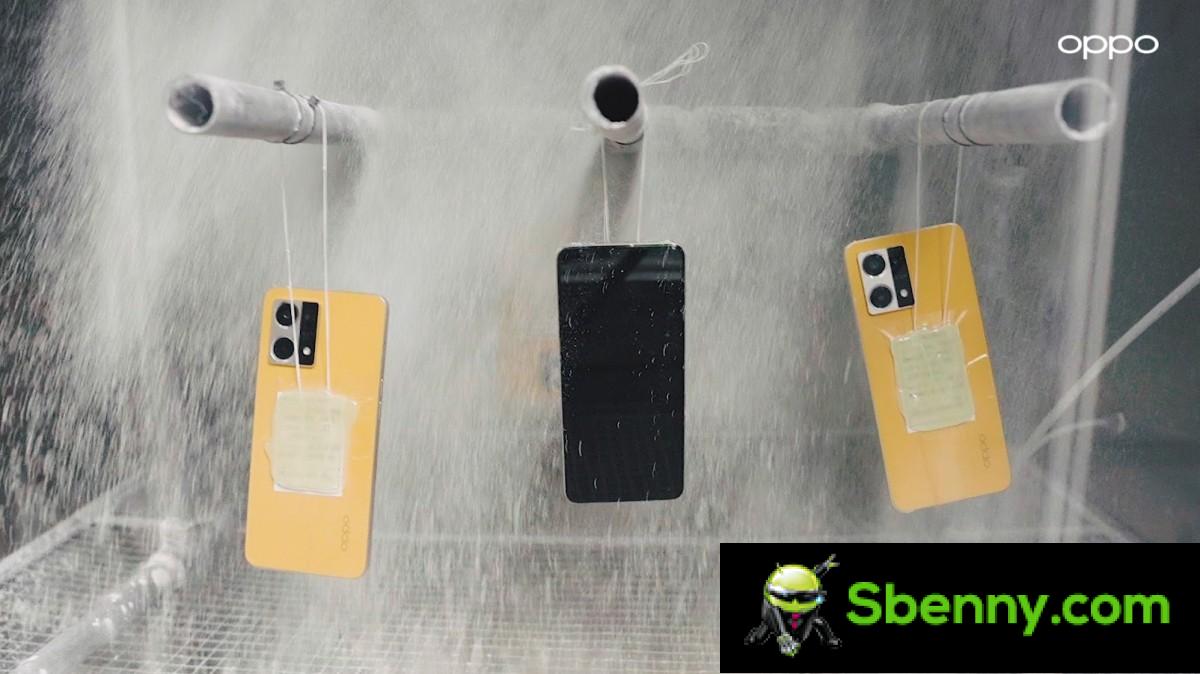
Simulation of heavy rain
With the kinetic tests carried out, waterproofing is the next item on the agenda. Oppo simulates heavy rain, 10 liters per minute, falling at 75 °, aiming for an IPX4 grade. The F21 series of phones was also soaked in 20cm of water for 30 seconds and then dried. After three days, the test unit is disassembled to check if water has entered and corroded the internal parts.
The quality of OPPO products is one of our top priorities.
The # OPPOF21ProSerie adopts IPX4 standard for water resistance testing and are also placed underwater at a depth of 20cm for 30 seconds to provide #OPPO Quality promise.
Buy now: https://t.co/pCd5DDpcte pic.twitter.com/L2t7LD2o3R– OPPO India (@OPPOIndia) April 29, 2022
Liquid water isn’t the only killer, electronics don’t like high humidity either. Hence, the phones enter a special chamber which maintains specific temperatures and humidity levels for several days. One of the tests keeps the phone at 95% relative humidity at 65 ° C for 14 days (instead of the standard 3 days). This is done with both the phone on and off.
The thermal shock test lasts 300 hours (four times longer than the industry standard) and checks if devices can survive temperatures as low as 75 ° C and as low as -40 ° C.

Special chambers test phones in various temperature and humidity conditions
Most water tests are done with fresh water, but salt water is more destructive. Then, the Oppo F21 phones are sprayed with salt water (5% salinity) for 2 hours, while kept in a warm and humid environment (50 ° C, 95% relative humidity). A positive grade in this test requires that the phone remain fully functional and show no signs of external damage.
Even the owner of the phone can damage the exterior of the device. The sweat test involves wrapping the phone in a cloth soaked in artificial sweat and leaving it for 24 hours. A selection of cosmetics is also tested for 24 hours to see if any of them will affect the exterior.

Oppo isn’t easy on its phones
Some of these tests are performed on all Oppo phones, others are specific to the F21 series, for example the leatherette tests. The phones also have an Orbit Light, which is a ring of RGB LEDs around the rear camera. These are tested for consistency and to ensure they last over 50,000 hours.
With refresh cycles getting longer, it’s great to see an increased focus on durability. Oppo’s tests ensure that the devices will continue to work even if you are a klutz and that they will look good when it comes time to sell them to a new owner.


Start a new Thread