
Xreal (née Nreal) has updated its Nebula application for Mac: the latest version allows Xreal headset owners to use virtual monitors or enjoy a virtual cinema experience.
Using Xreal Air or Xreal Light, the Nebula app can create three virtual displays: one that mirrors your MacBook’s display, plus two extended displays. Each can be adjusted and positioned as needed – you can change their size between 45” and 154” and bring them together up to 1.5m or push them outward to 9m (5-30ft). The displays can also be rotated by an angle if you prefer portrait over landscape orientation.
The headphones have 3DoF tracking, so the virtual displays will stay in a fixed position in space as you turn your head.

Xreal allows its employees to work on their own side projects, similar to other technology companies. If a project proves popular, the company invests more resources into developing it into a feature for its users.
This is the history of space cinema. Instead of three displays, this creates one big virtual silver screen so you can enjoy movies as intended. This can be used while traveling (so you don’t have to rely on in-flight entertainment) or simply at home as an extra large display.

You can find the Nebula app on the Xreal site. If you’re a Windows user, a Nebula app for Windows is also in the works. In addition to computers, Xreal headphones also work with iOS and Android phones.

Xreal Air is available in the US via the official website and Amazon priced at $380. If you’re in the UK, check with EE, the glasses are priced at £400.
The Air uses micro-OLED displays and has a 46° field of view, prescription lenses are supported. Typically, they’re powered via USB-C (from a MacBook or Android phone) or wirelessly. The first wireless option is the adapter, which works with iPhone, iPad, Xbox, PS5 and Switch, this costs $60. Alternatively, you can use the new Xreal Beam. We also mentioned the Xreal Light, but those are mostly aimed at AR developers, so the Air is the one to get as a user.
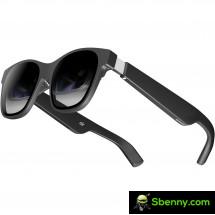
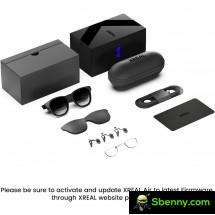
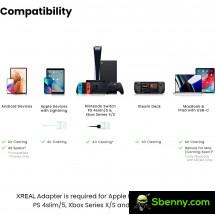
Xreal Air
Interestingly, Xreal says it saw a surge in sales after Apple announced Vision Pro. Rather than as a competitor, Xreal sees its goals aligned with Apple to promote so-called “spatial computing.”


Start a new Thread