
We put the Apple iPhone Air through our rigorous SBMARK Display test suite to measure its performance Cons four criteria. In the results of this test, we will analyze how it performed in a series of tests and in several common use cases.
Score
Subscores and attributes included in the overall score calculation.
 Apple iPhone Air

151

display
Label and attributes for eye comfort

Probability of perceiving flickering
% of the population
0.79
Minimum brightness
in nits
0.44
Circadian action factor
99%
Color
Consistency
compared to the Display-P3 color space
Pro
- Colors are pleasing and accurate both inside and out.
- Readable both inside and outside, favored by low reflectance.
- HDR videos are well rendered indoors.
Against
- Luminance and contrast are low below 0 lux, compromising readability.
- The brightness of HDR and SDR videos is low in low light conditions.
The iPhone Air display offers a balanced and refined viewing experience, offering smooth touch performance and significant improvements in readability compared to previous models.
In terms of readability, the iPhone Air makes a significant leap forward. While its reflectance management isn’t as advanced as that of the Samsung Galaxy S25 Ultra, it still outperforms most competitors, maintaining high visibility even in bright outdoor conditions. Its impressive peak brightness ensures comfortable use in sunlight, although in darker environments the default brightness may appear dimmed, requiring manual adjustment for ideal comfort.
Color rendering is one of the iPhone Air’s strong points. With True Tone turned off, colors appear exceptionally accurate, while turning True Tone on maintains a natural, pleasing balance in different lighting environments, ideal for everyday use.
During video playback, the iPhone Air offers a comfortable indoor viewing experience (approximately 800 lux). However, in dark environments, automatic brightness adjustments can make the image too dark, so users may prefer manual control to optimize visibility.
Touch responsiveness is a standout feature of the iPhone Air, providing fast, precise, and smooth interactions that improve navigation and gaming performance alike.
The iPhone Air also prioritizes visual comfort, earning the Eye Comfort Label certification. With a PWM frequency of 480 Hz and an optional Display Pulse Smoothing (PWM) mode located in (Settings → Accessibility → Display & Text Size), the display minimizes flicker-related strain at low brightness levels, making it an excellent option for users who value eye-friendly technology.
Test summary
About SBMARK display tests: For scoring and analysis, a device is subjected to a series of objective and perceptual tests under controlled laboratory and real-life conditions. The SBMARK Display Score takes into account the overall user experience provided by the screen, considering hardware capability and software optimization. Only factory-installed video and photo apps are used during testing. More in-depth details on how SBMARK tests displays can be found in the article “A Closer Look at SBMARK Display Testing.”
The following section focuses on the key elements of our comprehensive testing and analysis performed in SBMARK laboratories. Comprehensive reports with detailed performance evaluations are available upon request. To order a copy, contact us.
How the display readability score is composed
Readability evaluates the user’s ease and comfort in viewing stationary content, such as photos or a web page, on the display under different lighting conditions. Our measurements performed in laboratories are complemented by perceptual tests and analyses.
Skin tone rendering in an indoor environment (1000 lux).

From left to right: Apple iPhone Air, Samsung Galaxy S25 Edge, Google Pixel 10 Pro XL
(Photo for illustrative purposes only)
Skin tone rendering in a solar environment (>90,000 lux).

From left to right: Apple iPhone Air, Samsung Galaxy S25 Edge, Google Pixel 10 Pro XL
(Photo for illustrative purposes only)
SCI stands for Specular Component Included, which measures both diffuse reflection and specular reflection. The reflectance of a simple glass plate is around 4%, while it reaches around 6% for a plastic plate. Although the first surface of smartphones is glass, their total reflectance (uncoated) is usually around 5% due to multiple reflections created by the complex optical stack.
The average reflectance is calculated based on the spectral reflectance in the visible spectrum range (see graph below) and human spectral sensitivity.
Uniformity
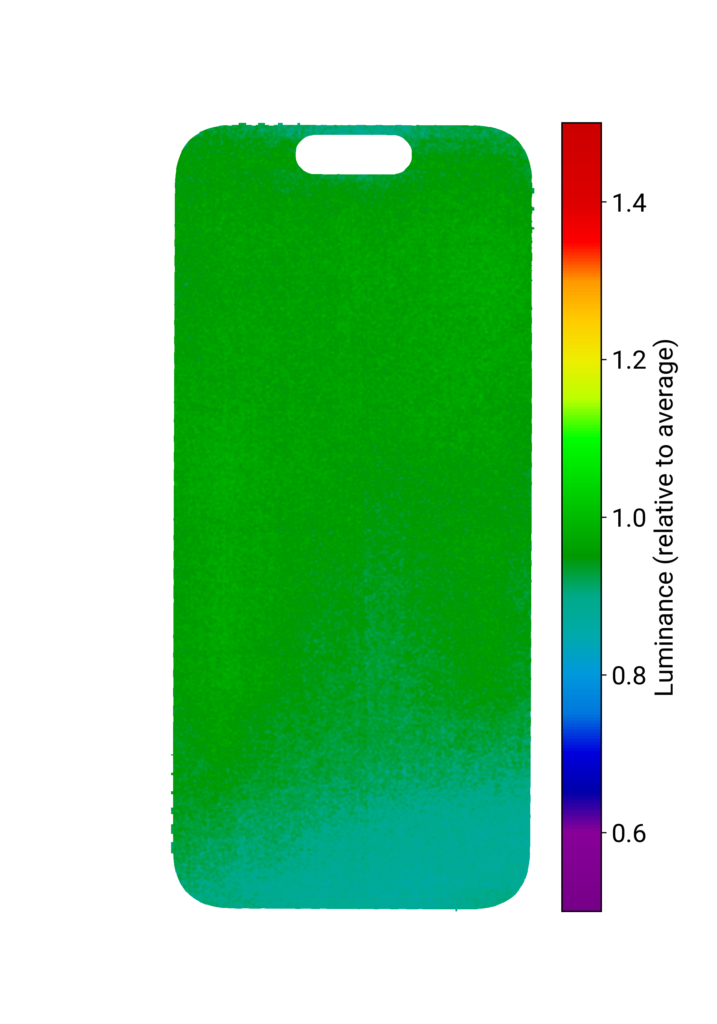
This graph shows the luminance distribution across the entire display panel. Uniformity is measured with a 20% gray pattern, with bright green indicating ideal luminance. An evenly distributed bright green color across the screen indicates that the display brightness is uniform. Other colors indicate a loss of uniformity.
Pulse width modulation is a modulation technique that generates pulses of variable width to represent the amplitude of an analog input signal. This measurement is important for comfort because low-frequency flickering can be perceived by some individuals and, in more extreme cases, can induce seizures. Some experiments show that discomfort can occur more frequently. A high PWM frequency (>1500 Hz) tends to disturb users less.
How the display color score is composed
Color evaluations are performed under different lighting conditions to see how well the device handles color with its surroundings. The devices are tested with sRGB and Display-P3 image models. Both faithful mode and default mode are used for our evaluation. Our measurements performed in laboratories are complemented by perceptual tests and analyses.
Circadian action factor is a metric that defines the impact of light on the human sleep cycle. It is the ratio between the light energy that contributes to sleep disturbances (centered around 450 nm, which represents blue light) and the light energy that contributes to our perception (covering 400 nm to 700 nm and centered around 550 nm, which is green light). A high circadian action factor means that ambient light contains strong blue light energy and is likely to affect the body’s sleep cycle, while a low circadian action factor means that the light has weak blue light energy and is less likely to affect sleep rhythms.
How the Display Video score is composed
The video attribute evaluates the handling of Standard Dynamic Range (SDR) and High Dynamic Range (HDR10) video in indoor and low-light conditions. Our measurements performed in laboratories are complemented by perceptual tests and analyses.
Video rendering in a low light environment (0 lux).

Clockwise from top left: Apple iPhone Air, Samsung Galaxy S25 Edge, Google Pixel 10 Pro XL
(Photo for illustrative purposes only)
Video rendering in an indoor environment (1000 lux).

Clockwise from top left: Apple iPhone Air, Samsung Galaxy S25 Edge, Google Pixel 10 Pro XL
(Photo for illustrative purposes only)
These indicators present the percentage of frame irregularity in a 30-second video. These irregularities are not necessarily perceived by users (unless they are all with the same timestamp) but are an indicator of performance.
How the Display Touch score is composed
We evaluate touch attributes in many types of content where touch is critical and requires different behaviors such as gaming (fast touch and response time), web (smooth page scrolling), and images (accurate and smooth navigation from one image to the next).


Start a new Thread