
We subjected the Oppo Find N to our rigorous SBMARK Display test suite to measure its performance Cons six criteria. In the results of this test, we’ll analyze how it performed in a variety of tests and several common use cases.
Overview
Main specifications of the display:
- 7.1-inch AMOLED, (~87.4% screen-to-body ratio)
- Dimensions: 132.0 x 73.0 x 15.9 mm (5.20 x 2.87 x 0.63 inch)
- Resolution: 1792 x 1920 pixels, (~370 ppi density)
- Proportions: none
- Refresh rate: 120Hz
Pros
- Good color fidelity in all lighting environments
- Smooth interaction in all tested use cases
- No frame mismatch when playing a video game
Against
- Poor video performance, with excessive contrast and insufficient brightness
- Brightness is too low when used outdoors
- Visible aliasing when playing video games
The display of the Oppo Find N, Oppo’s first foldable smartphone, provided a mixed viewing experience. We tested the display in its unfolded state and found that the screen brightness was better suited for indoor use. When taken outdoors, however, the screen brightness failed to exceed 600 nits (compared to other current foldable phones which can reach 1,000 nits), making content difficult to read. The screen also reflects too much ambient light, further compromising readability outdoors.
Otherwise, the display exhibited smooth interactions in all tested use cases: gaming, web browsing, and gallery viewing, with brightness levels well-suited for indoor use.
The Oppo Find N only displays images using the wider Display-P3 color gamut, which tends to give sRGB photos a more saturated look. But screen colors were generally accurate and consistent when viewing photos. The experience, however, wasn’t exactly the same when watching videos. Colors tended to be oversaturated, contrast was too strong, and brightness levels were too low to provide a satisfactory video viewing experience.
Trial summary
Learn about SBMARK display tests: For scoring and analysis in our smartphone and other display reviews, SBMARK engineers perform a series of objective and perceptual tests under real-life and controlled laboratory conditions. Please note that we evaluate display attributes using only the device’s built-in display hardware and its still images (gallery) and video apps with default settings. (For in-depth information on how we rate smartphones and other displays, check out our articles, “How SBMARK Tests Display Quality” and “A Closer Look at SBMARK Display Tests.”
The following section compiles the key elements of our extensive testing and analysis performed in the SBMARK laboratories. Detailed performance evaluations in the form of reports are available upon request. Do not hesitate to contact us.
How the display readability score is composed
Readability evaluates the ease and comfort with which users can read the still content (photos and web) on the display under various real-life conditions. SBMARK uses its Display Bench to recreate ambient light conditions ranging from total darkness to bright sunlight. In addition to laboratory tests, perceptual analysis is also performed in real-life environments.
Measurement of luminance uniformity

This graph shows display smoothness with a 20% gray pattern. The more visible the green color, the smoother the display.
How the Display Color score is composed
The color attribute evaluates the device’s ability to faithfully reproduce colors. Measurements taken include fidelity, white point color, and gamut coverage. We perform color assessments for different lighting conditions to see how well the device can handle color in its surroundings. Colors are measured using a spectrophotometer in a controlled lighting environment. The perceptual analysis of the color rendering compares with the reference model displayed on a calibrated professional monitor.
White point with illuminant D65 at 1000 lux

Color fidelity measurements

Oppo Find N, color fidelity at 1000 lux in the sRGB color space

Oppo Find N, color fidelity at 1000 lux in Display-P3 color space
Each arrow represents the color difference between a target color pattern (arrow base) and its actual measurement (arrow tip). The longer the arrow, the more visible the color difference. If the arrow stays inside the circle, the color difference will only be visible to trained eyes.
Color behavior on the corner

This graph shows the color shift when the screen is tilted. Each point represents a measurement at a particular angle. The dots within the inner circle show no color change in the corner; those between the inner and outer circle have shifts that only trained experts will see; but those which fall outside the outer circle are evident.
How the soundtrack of the Display Video is composed
Our video attribute evaluates each device’s Standard Dynamic Range (SDR) and High Dynamic Range (HDR10) video handling in indoor and low-light conditions. We measure the tone mapping, color gamut, brightness and contrast of the display. We perform perceptual analysis Cons our professional reference monitor (Sony BVM-HX310) to ensure rendering respects artistic intent.
Gamut coverage for video content
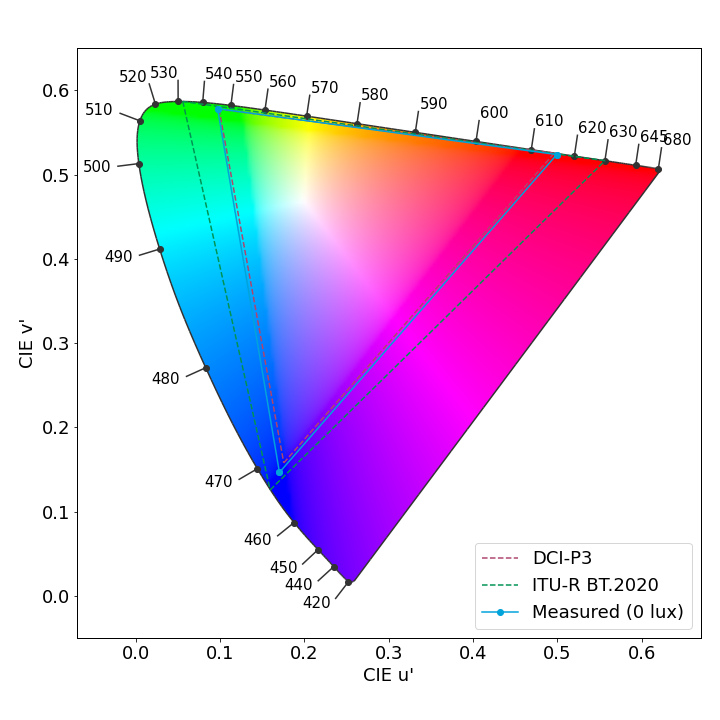

Primary colors are measured in both HDR10 and SDR. The extracted color gamut shows the extent of color area that the device can render. To meet artistic intent, the measured gamut should match the primary color space of each video.
How the Display Motion score is composed
The motion attribute evaluates the handling of dynamic content. Frame drops, motion blur, and playback artifacts are examined using games and videos.
The video frame drops


These long exposure photos feature the number of frame irregularities in a 30 second video. Good performance shows a regular pattern (a flat gray image or a pull-down pattern).
How the Display Touch score is composed
To evaluate touch, SBMARK uses a haptic robot and a high-speed camera to play and record a series of scenarios for fluency, accuracy, and response time evaluation.
This response time test accurately evaluates the time between a single tap of the robot on the screen and the displayed action. This test is applied to activities that require high responsiveness, such as gaming.
How the display artifact score is composed
Evaluating artifacts means checking performance, image rendering, and motion artifacts that can impact the end-user experience. SBMARK accurately measures device reflectance and flicker, and evaluates the impact of residual aliasing when playing video games, among other characteristics.
Aliasing (foreground)

Oppo Find No
(Photos for illustration purposes only)


Start a new Thread